imperial Hofburg
Innsbruck
Tyrol, Austria
europe
march 18, 2011


imperial Hofburg
Innsbruck
Tyrol, Austria
europe
march 18, 2011

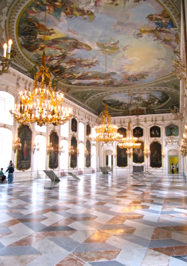
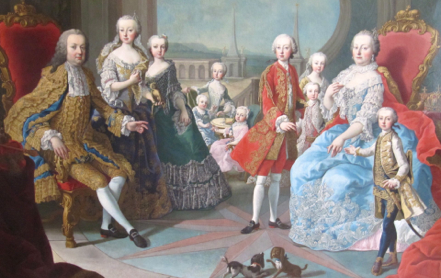
A second tour of the Hofburg was even more splendid than the first tour Henry and I made of this imperial palace in 1999. Since that date, the palace has been restored and organized to feature a museum of furniture and furnishings dating from the period of Archduke Karl Ludwig of Austria, who lived in the palace during his tenure as Governor of Tyrolia,. He furnished the imperial apartments for his elder brother, Franz Josef, Emperor of Austria and the Empress Elizabeth, known as “Sissy”, who stayed in their apartments during state visits to Innsbruck. The palace was originally built as a castle under Archduke Sigmund c. 1480’s, completed under Maximilian I c. 1500 with the same dimensions as the Hofburg today. At that time, the architecture was Medieval, and a Heraldic Tower rose up in the southeast corner, a prestigious artifact depicting symbols of power and territory governed by Maximilian I. Maria Theresa no longer found the castle suitable, and commissioned the rebuilding in two stages: 1756, before the Seven Years War, and again, into the 1770‘s. An Innsbruck architect, Johann Martin Gumpp was given responsibility for the renovations. Later, the Viennese architects Nikolas Picassi and Konstantin von Walther undertook the later phase including the Rennweg façade. The interior design was by Martin van Meytens and Franz Anton Maulpertsch who created an overall late Baroque work of art culminating in the Giant’s Hall. This grand room, known by Maria Theresa as the “family room” broke with imperial Habsburg tradition. As the only female heir to the Habsburg dynasty, instead of decorating the high ceilinged ball room with portraits of her ancestors, she commissioned portraits to line the room in baroque frames, those portraits including herself, her husband, Emperor Francis I, their son, Josef, heir to the throne, plus all her daughters, sons, and grandchildren, presented equally, despite their gender. The ceiling frescoes, depict the unification of the houses of Habsburg-Lorraine and the regalia of the Tyrol. The imperial family took residence in the Hofburg in 1765 in anticipation of the wedding of their son, Archduke Leopold to the infanta, Maria Ludovica of Spain.
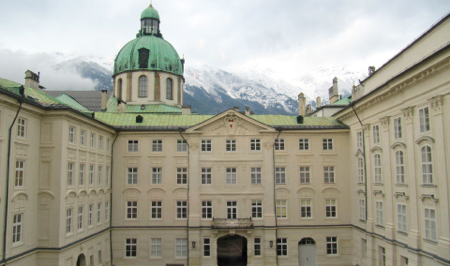
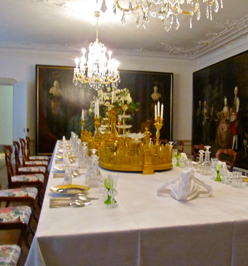
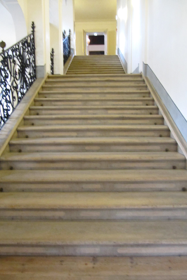
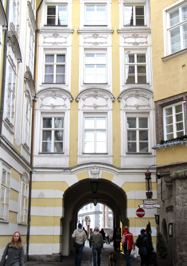
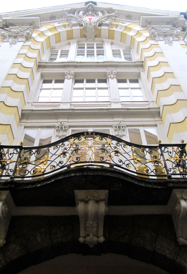
PHOTOS: Left Column: 1. Interior courtyard of Imperial Hofburg, known as the “Little Schönbrunn of the Alps”. 2. The Hall of Giants, known as the “Family Room” by Maria Theresa. 3. Family portrait depicting Francis I and Maria Theresa with nine of their children. Maria Theresa, Habsburg empress, gave birth to sixteen children, 13 of whom lived to maturity and many of whom became leading figures with European countries, cementing ties to the Habsburg dynasty. The paintings in this hall include all her children, including the three who died. Both genders and her grandchildren are also depicted. Notable is the portrait of Maria Antonia, known as Marie Antoinette, who married King Louis XVI of France. The empress’ son Josef, heir to the throne, was depicted on the wall, among the three separate portraits of Francis I and Maria Theresa. Center, Middle: Dining Room at the Hofburg, with the table set, each place setting with five glasses. The silver was stamped with the monogram of the Habsburg double eagle. The table centerpiece of filigreed gilt ormolu with mirrored sections enabling it to be extended to approximately 35 meters/114 feet. Right Column: 1. Exterior Detail: Imperial Hofburg palace. 2. An archway through the Hofburg leads to the Hofkirche or High Church and Memorial Cenotaph of Maximilian I. 3. The Grand Staircase with its twin flights of steps, is one of the most striking changes made at the time of Maria Theresa. The spacious late Baroque entrance was planned by Innsbruck architect Johann Martin Gumpp the Younger, who was given responsibility for the conversion of the Hofburg.

Innsbruck’s Royal Palace