the Lower park
the great palace • peterhof palace
outskirts of St. Petersburg, russia
july 12, 2011

the Lower park
the great palace • peterhof palace
outskirts of St. Petersburg, russia

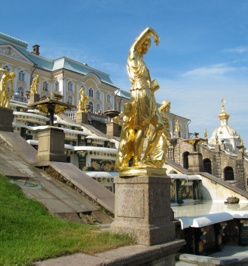
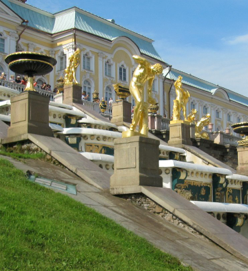
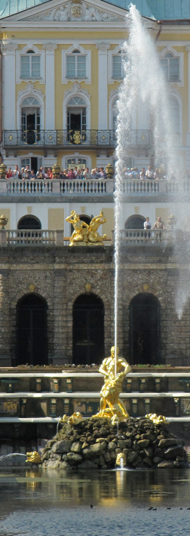
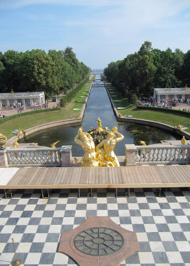
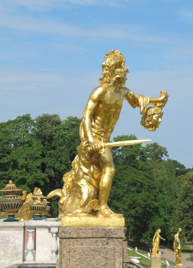
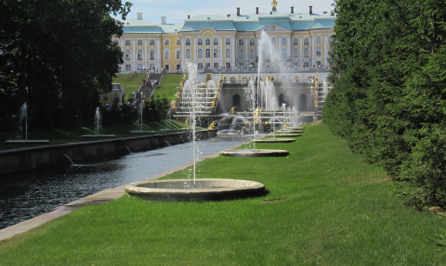
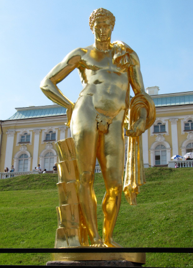
The Lower Garden of Peterhof, part of the original grand design of the summer residence of the emperor, reflects the main idea behind the complex: the glorification of outstanding victories of Russia in its struggle for the Baltic shores. On the north side of the Great Palace is the garden extends 100 meters/328 feet from the sea, its area measuring an immense 102 hectares/252 acres. The central focal point of the garden is the Great Cascade conceived by Peter the Great himself. The Emperor chose this site for his summer residence after he found water reservoirs fed by underground springs 20 kilometers south of the palace site. In 1721, a water supply system was built, and water flowed by gravity to the Peterhof storage pools. When released, the water rushes through pipes and erupts in a number of water jets in the fountain of the LowerGarden. The composition of the Great Cascade was realized by the architects Jean-Baptiste Le Blond and Niccolo Michetti. One of the most distinctive features of the Peterhof site is a man-made cliff measuring 16 meters/52 feet in height that separates the Upper and Lower Gardens. Over 200 meters/656 feet long, this architectural cliff in the landscape was constructed of sturdy stone. During Peter’s reign, the two-story grottos were built of imported stone, the balustrade erected, and a dozen allegorical figures were cast in Holland to decorate the two seven-step cascades. After his death, his ideas continued to be implemented. In the 19th century, for example, the original cast lead sculptures of the Great Cascade were replaced with gilded bronze statues crafted by the the eminent sculptors of the period such as Fedor Shchedrin, Jean-Dominique Rachette, Fiodor Shurbin, Ivan Prokofyev, Ivan Martos and Mikhail Kozlovsky. The center of the water pool that connects the sea by canal on a north-south axis of Peterhof’s ground plan, divides the park into two parts. On either side of the canal, avenues lead from the Great Parterres to the sea the depth of the park, with twin fountains decorated by the sculptures of Adam and Eve, commissioned by Peter the Great from the Italian sculptor, Giovanni Bonazza. Numerous other fountains punctuate the formal designs of the property. The central pool at the base of the Great Cascade is a focal point of the grand design, its central island facing the Baltic Sea. Adorned by the statue of Samson Rending Open the Jaws of the Lion by M. Kozlovsky c. 1802, it is the main feature of the most powerful fountain in Peterhof. The Sampson Fountain, conceived as early 1734 when the 25th anniversary of the defeat of the Swedish troops at Poltava was celebrated, was inaugurated on June 27, 1909, the feast day of Samponius. This auspicious day suggests the symbolism of the biblical hero Samson and a lion, an allegory symbolizing Russia’s victory over Sweden, as the lion depicted on Sweden’s coat of arms.
PHOTOS: Top Two: 1. The Lower Gardens with the central fountains and cascades fully activated. 2. A view of the northern terrace as seen from the palace. Two sculptural figures of tritons trumpeting conch shells, seen from the back, was modeled by Carlo Bartolomeo Rastrelli were installed overlooking the lower grotto. The pool in front of the grotto connects the palace to the Baltic Sea along a canal that divides the Lower Park into two sections. Middle Two: : 1. View of some of the gilded sculpture and ornamental bowls on the Great Cascade, eastern staircase, a pair of wide marble staircases where water flows to the lower park. 2. Example of one of the gilded copies of Roman sculpture that ornament the Great Cascade. Bottom Two 1. View of some of the gilded sculptures on the western staircase of the Great Cascade. 2. Gilded sculpture of David with the Head of Goliath, positioned at the top tier, eastern side of the eastern staircase of the Great Cascade. Bottom Right: 2. The Samson Fountain. The image of Samson, representing the strength of Russia holding open the mouth of the lion, representing Sweden. The strong column of water shoots 20 meters/65 feet upward from the mouth of the lion. The symbolism of the fountain represents Russia’s defeat of Swedish troop at Poltava in 1709. The title of the fountain is: Samson Rending Open the Jaws of the Lion Fountain by sculptor M. Kozlovsky, 1802.

The Samson Fountain & Great Cascade