Iban longhouse
sarawak cultural village
kampung budaya, pantai damai santubong
sarawak, east malaysia, borneo
April 25, 2009


Iban longhouse
sarawak cultural village
kampung budaya, pantai damai santubong
sarawak, east malaysia, borneo
April 25, 2009

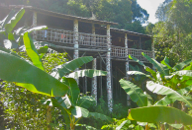
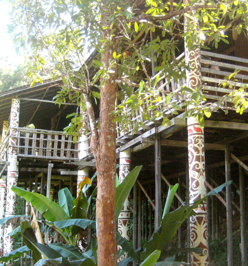
The Iban people, once known as “Sea Dayaks”, built their longhouses to last between fifteen and twenty years, or until the farmland in the surrounding area was exhausted. At that point, the whole extended family of longhouse residents moved upriver, along the coast, and resettled what appeared to be promising terrain. Approximately one-third of the population of Sarawak is Iban, many of them now living in towns and in individual houses, but a large majority still preferring to live in longhouses. These houses are always built along the banks of a navigable river. Visitors to the longhouse always arrive by boat. The guests then climb up a notched log that serves as a staircase, to an open verandah, scene of the community and domestic activity. Several doorways lead from the outer to the inner verandah, which is under a roof. This inner verandah is the village street of the longhouse. The doors of each individual family apartment opens onto the common walkway, covered in mats. The visitor may be invited to sit on a mat, chat with the longhouse elder, and be joined by other residents of the longhouse. The size of the longhouse depends on the number of families who reside here, and the size of the community is equated by the number of “doors” in the longhouse. I have talked to various members of hotel staff, who have told me the size of their longhouses where they live, the largest we heard about being 100 doors! All matter of community ceremonies take place in the common areas of the longhouse, yet each family has their rooms and privacy within each “apartment”.
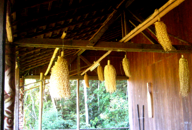
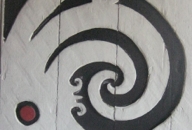
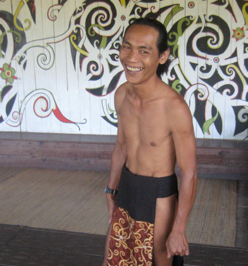
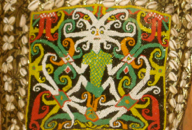
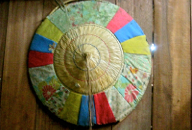
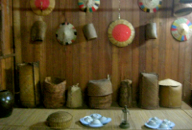
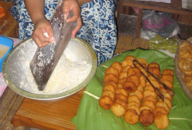
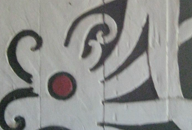
PHOTOS: Left Column: 1. View of the longhouse, with carved and painted posts. 2. Detail: carved and painted architectural decoration. 3. An Iban hat with pieced cotton fabric trim. 4. A member of the Iban tribe grating coconut for cookies that were fried in palm oil. Delicious! Center, Top: View of the longhouse, with carved and painted posts. The extended portion of the verandah, not always built in a longhouse community, is a place for the chief or elder, where meetings are held. Center, Bottom: Iban tribe member, wearing his native attire. He stands before a painted mural on the verandah of the longhouse. Right Column: 1. Typical decorations on the longhouse verandah. A portion of a tree is shaved into curled strands and hung from the ceiling, especially during festivities and ceremonies. It has been described to me as “early crepe paper”. 2. Detail: carved and painted architectural decoration. 3. A beadwork square decorating a baby basket, used for carrying infants on the mother’s stomach. 4. A dining platform, covered with woven mats, in the longhouse. Cups and bowls are set out on trays. Baskets surround the perimeter, and hats and useful objects decorate the wooden walls.

“Sea Dayaks”