Kuang Daing village
Inle Lake, Central Highlands,
Eastern myanmar, southeast asia
september 6-10, 2009


Kuang Daing village
Inle Lake, Central Highlands,
Eastern myanmar, southeast asia
september 6-10, 2009

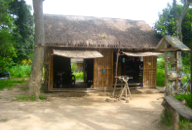
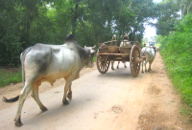
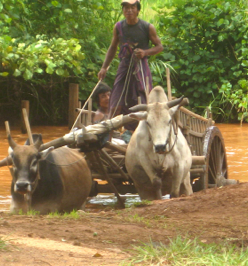
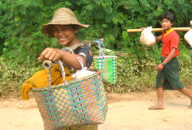
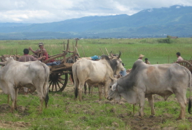
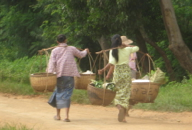
In our travels, in Southeast Asia in particular, Henry and I often found life reduced to its most basic. Electricity didn’t exist in some villages, though gasoline generators sometimes supplied a source of fuel. Gasoline was sold by the liter, and transportation was often most common by foot. A farm implement, a motor that could be used to mechanize a plow, commonly known as an “all purpose farm vehicle”, was also used to haul goods, when attached to a truck-like wagon. We couldn’t help but notice how fit the rural people were, simply because their life demanded that they work physically to get things done. As in Vietnam, the bamboo pole was slung across the shoulder to balance a heavy load carried in baskets. Clothing was simple, with long wrapped longyis being the traditional dress for both men and women, although some of the farmers wore a simple drawstring trouser. Hats of all description were worn, including a terry cloth towel wrapped around the head. The peaked hats of Burma were beautifully made of bamboo, stitched in place on wooden frames to make them sturdy. Babies were toted in woven cloth slings, and their presence seemed to delight everyone. Housing was also basic with bamboo mat walls, pounded earth floors, and thatched roofs, often elevated above ground on stilts. A more substantial building made of stucco was also common, not only in the country, but in the cities as well. Dogs, chickens and roosters, plus cattle and the heavy wooden oxcarts occupied the land between the house and the single lane road. The Burmese ate healthy, fresh food which was plentiful, as the land was fertile and they were adept at farming, fishing, and raising livestock. Very little of the modern world had crept into rural Myanmar, and the people here seemed to live the same lifestyle they had inherited it from their ancestors. Kuang Daing was a peaceful community, interrupted only by the chanting of the Buddhist monks in preparation for their big celebrations at the end of September; and, the arrival of the market that descended on the village every five days.
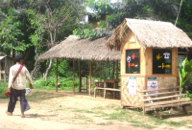
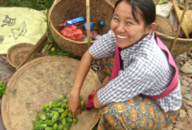
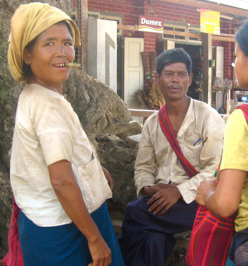
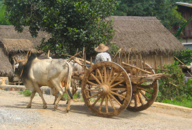
PHOTOS: Left Column: 1. A bull, tethered to the wooden ox cart, being pulled along down the one-lane road of Kuang Daing Village. 2. A thatched hut building with walls that open as awnings. This was the village bicycle repair shop. 3. Three women, all wearing longyis, returning home after shopping in the village market. Bamboo poles help support the weight of large baskets filled with goods. 4. A young woman and a young man, both carrying their market purchases on bamboo poles balanced on their shoulders. Center, Top: A village farmer fording a river tributary with his oxcart and team. We noticed him because he was struggling to make the animals climb the muddy bank, then gave up and tried another spot downstream. Center, Bottom: Some village farmers caught in conversation. The woman on the left has a local cigar in her mouth and wears a cloth wrapped around her head. Right Column: 1. A village woman with her baskets of produce. Tomatoes are one of the best crops grown at Inle Lake. 2. A villager, who has noticed the telephone information sign on the little hut near the road. 3. A farmer in his oxcart with his team of cattle. Thatched roof buildings are in the background. 4. Oxcarts and cattle in the field behind the market stalls. The mountain background is on the opposite side of Inle Lake.

The Simple Life