Traditional Weaving studio
amarapura
central myanmar, southeast asia
september 13, 2009


Traditional Weaving studio
amarapura
central myanmar, southeast asia
september 13, 2009

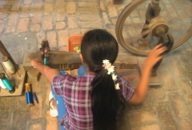
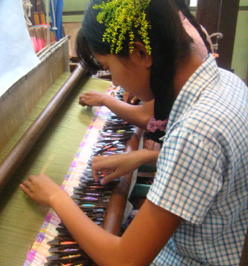
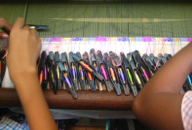
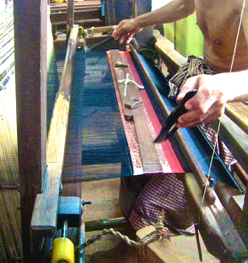
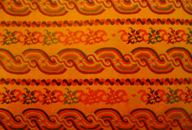
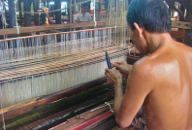
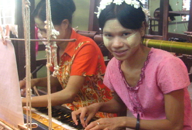
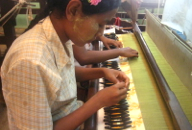
In the town of Amarapura, our guide drove us to a traditional weaving factory, Tein Nyo Loon Yar Kyaw. We walked into the factory, uninterrupted, to have a look around. I was mesmerized by what Henry and I saw before us. A large open room was filled with big rectangular looms, or yakan, with seats built into the frame. Upon these one or two people, mostly young women, sat weaving complicated patterns. Each loom was warped with silk thread, and. the workers were employing the most distinctive weaving technique, a tapestry weave employing lun-taya, “one hundred shuttles” or more, often twice that. These threads are woven under and over the warp to create weft acheik (wavy patterns). Si (tie-dyeing, literally “tying together, binding”) is done by dyeing the thread in various colors to form a pattern and sealing them individually with bindings to safeguard the colors prior to dyeing the whole. The technique is usually employed in creating weft patterns but sometimes is used to make a design in the weft and warp simultaneously. Popular also is the supplementary weft technique whereby extra threads are woven into the weft to introduce patterns beyond the basic design. Another technique, one derived form north-eastern Thailand and used in Ban-gauk (Bangkok) longyis, involves the use of two-tone, two-ply twisted silk threads in the warp to create a lustrous sheen and subtle patterns. At the back of the factory, a lone man worked on a complicated pattern with many treadles operating the loom. His thread included shuttles of gold, deftly woven through the pattern. The Myanmar people still continue to wear their traditional dress, which is both practical and elegant. These silk fabrics are worn as traditional longyi, their elegant weaves reserved as wedding gowns and formal wear. To honor the occasion, a matching jacket or blouse made of the same fabric would complete the ensemble.
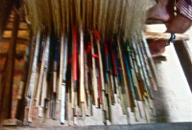
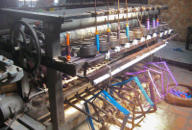
PHOTOS: Left Column: 1. Young women working on a loom. 2. View of the lun-taya or one hundred shuttles (or more) to weave the traditional acheik patterns. 3. A young woman spinning thread. 4. An automated machine which fills bobbins with thread. Center, Top: Weavers using the lun-taya to weave the complex wavy patterns of acheik. Center, Bottom: A man at his loom weaving threads of gold into a complex silk fabric. Right Column: 1. Young women at the yakan loom, with seats built into the large rectangular wooden frame. 2. Example of the traditional silk fabric known as acheik, with complex wavy patterns of many colors. 3.View of the yakan loom,with a weaver working with gold thread on a shuttle. 4. Dozens of treadles operated by the feet, each holding a different color warp thread. When combined this creates a complex traditional silk fabric.

Complex Traditional Designs