Cornelius Gijsbrechts
national gallery of denmark
SMK: Stadhaus Museum for Kunst
Copenhagen, Denmark
northern europe
JUly 17, 2011


Cornelius Gijsbrechts
national gallery of denmark
SMK: Stadhaus Museum for Kunst
Copenhagen, Denmark
northern europe
JUly 17, 2011

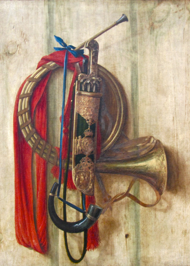
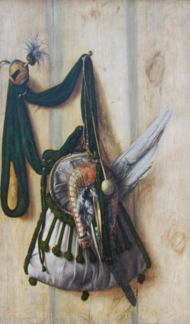
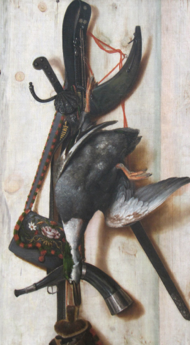
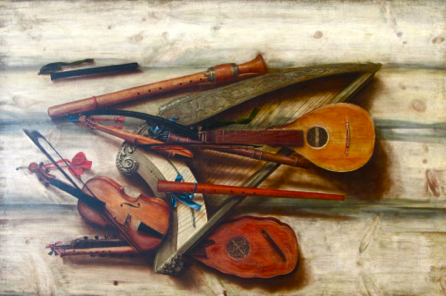
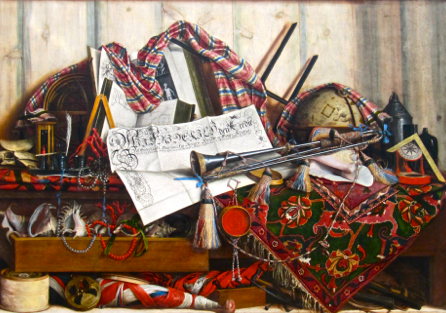
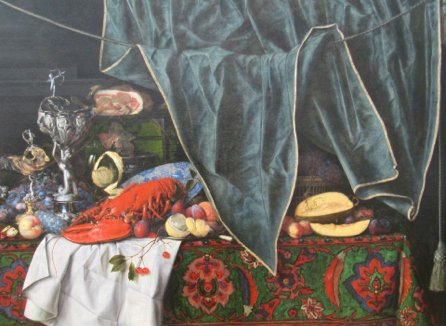
During the latter part of the 13th century, the great Medieval painter, Cimabue arrived to work at this studio, picked up his brushes and climbed the scaffolding to continue work on this thirteen-foot tall image of his famous painting, Madonna Enthroned. When he reached the top of the scaffolding, he found a fly on the nose of the Madonna that he had painted only a few days before. Given the fact that the paint medium was made from egg yolks, flies and other insects were often a problem when the paint was fresh. He tried three times to frighten off the fly, only to realize that one of his apprentices, Giotto, had painted the fly on the Madonna’s nose as a practical joke This incident was perhaps the beginning of the painting style named by the French as trompe l’oeil or “fool the eye” painting. There’s no doubt that such work became a presence in art, as today we see it in various forms known as “Super Realism” or “Photo Realism”, as well as in traditional and non-traditional still-life paintings. It is a type of painting that, while not spectacular, is something of a spectacle, beloved by realist artists as a means of showing off their technical virtuosity, and by viewers for its magic in fooling their eyes, if only for a moment, into confusing reality with illusion. It’s an art that was mastered by the Flemish artist, Cornelius Gijsbrechts (1630-1683), who was active as a painter in the second half of the 17th century. His first known paintings date from 1659 in Antwerp. In 1665, he painted in Regensburg, from 1665-1668, in Hamburg, and from 1668-1672 in the royal court in Copenhagen, where he was employed by the Danish kings Frederik III and Christian V. In the 17th century, representations of the artist painting in the studio were common in Northern European art. Gijsbrecht’s innovative contribution, in his adaptation of this genre into the context of trompe l’oeil, completely omitted the artist from the scene. In his complex and multi-faceted artistic identity, he cleverly alludes to and celebrates his craft through the prominent display of his tools and the unexpected absence of the body. By taking into account the collecting practices of the Danish Kings, his paintings can be seen as an integral part of the 17th-century interest in perspective, artifice, and the marvelous. The artist, in producing this illusionistic work, has been considered to be almost as much a magician as a painter. When he was painting at court in Copenhagen, he played to and impressed a royal audience. When Frederik III died, he continued to paint for the court under Christian V. This king built a museum with an entire room devoted to the paintings of Christian Gijsbrechts’ astonishing images. Several of his more traditional paintings have the typical vanitas elements of burning candles, flowers, bubbles, food, insects, etc., though often with a twist. His canvases had trompe l’oeil torn spots, frayed edges, dirt and grime, often painted to mirror the actual thing, juxtaposing image with reality. Paintings by a second Trompe L’oeil specialist of the same era were also in this special gallery of the National Gallery of Denmark. Franciscus Gijsbrechts, probably a relative of Cornelius Norbertus Gijsbrechts, painted in a similar vein. He, too was a master of Trompe L’oeil, and chose as his subject matter the contents of cabinets. The two were both members of the Antwerp Guild, and there is some evidence that Franciscus Gijsbrechts, also painted at the royal court of Denmark. His paintings are rare and there is little known of this painter; however, this one painting offers comparison between the styles of these two trompe l’oeil specialists.
PHOTOS: Left Column: 1. Franciscus Gijsbrechts, Board Partition with Musical Instruments, 1672. 2. Cornelius Norbertus Gijsbrechts, Trompe L’oeil with Trumpet, Celestial Globe, and Proclamation by Frederik III, 1670. 3. Cornelius Norbertus Gijsbrechts, Trompe L’oeil with Breakfast Piece and Goblets, 1672. Right Column: 1. Cornelius Norbertus Gijsbrechts, Trompe L’oeil with Dead Duck and Hunting Implements, c. 1672. 2. Cornelius Norbertus Gijsbrechts, Trompe L’oeil with Hunting Knife and Hunting Horn. Equipment for Riding to the Hounds. 1671.3. Cornelius Norbertus Gijsbrechts, Trompe L’oeil with Falconry Bag and Other Equipment for Falconry. 1671.

Trompe L’oeil Paintings