danish & nordic Art
national gallery of denmark
SMK: Stadhaus Museum for Kunst
Copenhagen, Denmark
northern europe
JUly 17, 2011


danish & nordic Art
national gallery of denmark
SMK: Stadhaus Museum for Kunst
Copenhagen, Denmark
northern europe
JUly 17, 2011

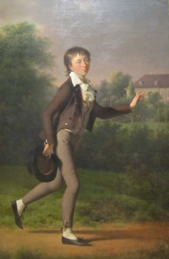
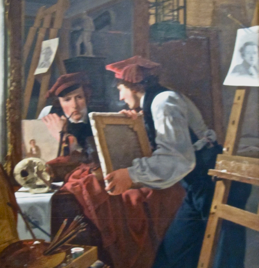
The galleries of SMK, Stadhaus Museum for Kunst, also known as the National Galleries of Danish Art, exhibit a range of painting and sculpture from Denmark and the Nordic countries that date between 1750 and 1900. The works of art depict the changing political climate through the subject matter and aesthetic choices made by the artists. The exhibition begins with works of art produced between 1750 and 1800. These decades represent the last flourishing period of the Danish absolute monarchy, when king was the unrivaled center of the country, actively supported by the nobility. All of the most prominent artists of the period were associated with the court. The middle class. however, was on the rise and strove for greater influence, both financially and culturally. Though there was no violent revolution in Denmark as existed in France in the late 18th century, the structure of power gradually changed. Middle-class values gained ground and art took on a more realistic quality. The second half of the 18th century gave rise to an all-new view of nature inspired by the Swiss philosopher, Rousseau. Nature was no longer something to be conquered, but existed as a interplay with man. Jens Juel painted several of his subjects outside in nature, first in Switzerland (1777-79) , then back in Denmark. Rousseau’s thinking was that children were no longer regarded as small adults, but as young human beings with individual needs. Juel painted A Running Boy in 1802, headed for his Copenhagen school, the first to have a playground. 1800 to 1850 marked the Danish Golden Age. By 1840, the patriotic notion of a distinctly national character became central within political and cultural discussions. This focus was prompted by the mounting strife regarding the affiliations of Schleswig and Holstein to the Danish kingdom. The German population wanted independence from Denmark to form a closer alliance with the German states, resulting in a war whereby Denmark was victorious, but later lost the territory to Prussia. Many younger Danish artists began to focus on Danish motifs. During the Late Golden Age, 1840-1880, many Danish artists traveled, entering into a dialogue with European artists of their day. These artists worked in direct opposition to the dominant Danish trend that cast skepticism toward artists who looked to the international art scene and chose to work abroad. Characteristic features amongst works by the “Europeans” included theatrical effects, brownish colors, and an international range of subject matter including oriental scenes. This somewhat heavy-handed rhetoric ran counter to the Danish personality with its modesty and focus on the simpler way of life. Capitalizing on this idea of introspection, the last painting illustrated on this page, and one of the the paintings in the final room of the gallery’s exhibition of Danish and Nordic Art, is a self-portrait by Wilhelm Bendst at the age of 22. The artist employs an age-old technique, looking in a mirror to see if a drawing “works”, a trick of the painter’s trade. In this case, the painting reveals how even an artist can have difficulties seeing who he is and what he is doing. There is something wrong everywhere within this image. Diagonals are blocked. The painting is full to the bursting point. Even the face of death has toppled. The smooth mirror that was supposed to reflect the world in truth is split in two. The world has been cut in half. The truth about identity is not straight forward. The French philosopher Jacques Derrida has said that portraits actually lament the fact that you cannot see what you are doing as you draw or paint the portrait because your hand and tools block your view. Portraits are done blind. Thus, the portrait does not represent reality, but a struggle between blindness and memory.
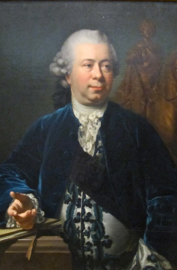
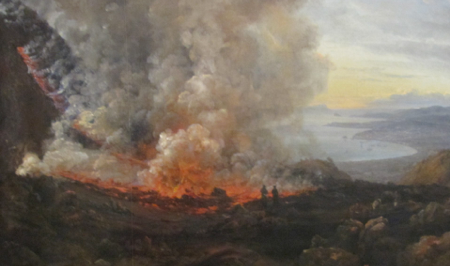
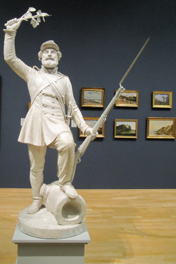
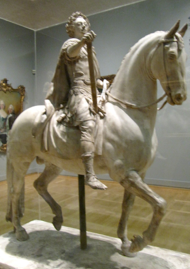
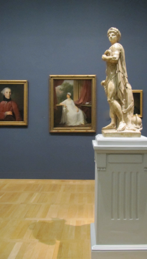
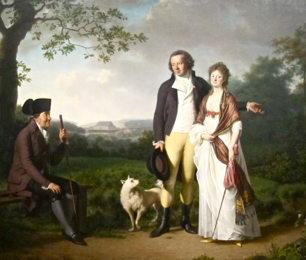
PHOTOS: Top Three 1. Jens Juel (1745-1802, Danish) A Running Boy. Marcus Holst von Schmidten, 1802. 2. View of works of art in the first gallery. The sculpture, Allegory of Patriotism, is by Jacques François Joseph Saly (1717-1776, French). 3. Jens Juel (1745-1802, Danish) Niels Ryberg with his Son, Johann Christian and his Daughter-in-Law, Engelke, née Falbe, 1797. Middle Two: 1. Johan Christian Dahl (1788-1857, Norwegian) The Eruption of Vesuvius, 1820. 2. Herman Wilhelm Bissen (1798-1868, Danish) A Victorious Danish Soldier, 1850. Bottom Three: 1. Jacques François Joseph Saly (1717-1776, French) Friderik V on Horseback Sketch for Equestrian Sculpture in Amalienborg Palace Square, 1758. 2. Jens Juel (1745-1802, Danish) Jacques François Joseph Saly /The Sculptor, 1772. 3. Wilhelm Bendz (1804-1832, Danish) A Young Artist Examining a Sketch in a Mirror, 1826.

1750-1900