the royal mews
BUCKINGHAM PALACE
LONDON, ENGLANd
gREAT BRITAIN, THE United Kingdom
OCTOBER 1, 2010


the royal mews
BUCKINGHAM PALACE
LONDON, ENGLANd
gREAT BRITAIN, THE United Kingdom
OCTOBER 1, 2010

The Royal Mews of Buckingham Palace is like a small village behind the palace walls, housing the stables and the living quarters for the employees and the families of the grooms, carriage drivers, and chauffeurs for the British Royals. This living museum was a fascinating place to visit along with Buckingham Palace and the Queen’s Galleries. The three venues, available only when the queen is away on her annual visit to Scotland in the summer, added another dimension to our knowledge about the monarchy and its history; plus, revealed a royal collection of art, furniture, horses, automobiles, and carriages held by the Queen. The Royal Mews are considered to be some of the finest working stables in existence. The staff of the Royal Mews are in the Department of the Royal Household, and are charged with the transport by road of the royal family including special ceremonial occasions. These engagements include State Visits, Royal Weddings, the State Opening of Parliament and other official engagements. State ceremonies have recently included the Queen’s 2002 Golden Jubilee celebration. Included in the exhibition of carriages, limousines, stables and horses was a video loop of the coronation ceremony of Her Majesty, Queen Elizabeth II c. 1953, a special event to view, even 57 years later.
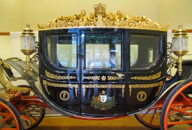
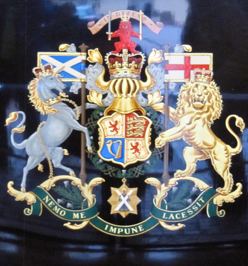
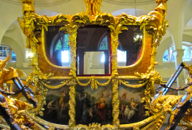
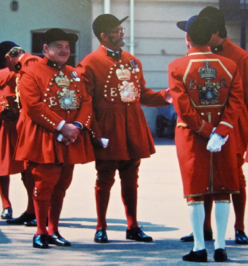
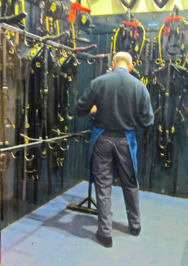
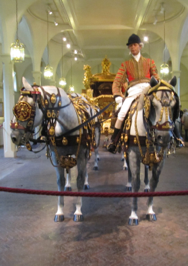
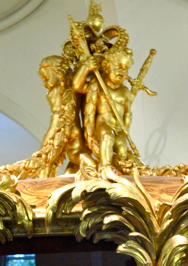
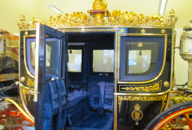
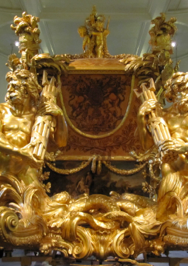
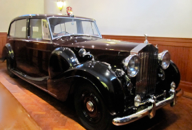
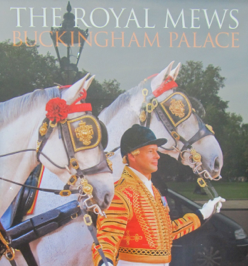
PHOTOS: Left Column: 1. The Irish State Coach, a carriage built for Queen Victoria and her husband, Prince Albert. Built by John Hutton & Sons of Dublin in 1851. The gold crown was added after Queen Victoria became the Empress of India in 1876. The design includes the rose of England, the thistle of Scotland, the Irish shamrock, and the palm tree representing India. After the death of Prince Albert, the queen refused to use the gold coach, but used the Irish State Coach on the few State ceremonies she attended. Rebuilt in 1911 after a fire destroyed the woodwork on the interior, the coach was put into service as part of the procession for the coronation of King George V. The interior is a royal blue velvet. 2. One of five state limousines in the Royal Mews: two Bentleys and three Rolls Royces. Until 2002, the Queen’s official cars were built by Rolls Royce, when the first Bentley was presented. 3. The Australian State Coach was presented to the Queen in Canberra in 1988. The first royal coach to be built since 1902, a small team of technicians combined traditional techniques with modern technology to build a coach with electric windows and air conditioning. The underpinnings are made of Australian hardwood, and the lamps are Waterford crystal, cut and engraved. On the door is painted the Australian Coat of Arms, supported by a kangaroo and an emu. 4. Detail: the Coronation Coach, c. 1762: The branches of eight gilded palm trees frame the roof. Four corner palm trees rise from a lion’s head and are decorated with symbols representing the British victory in the Seven Year’s War with France. The war was drawing to a close when the coach was built. Morocco leather straps support the coach and are held by four Tritons, mythical sea gods with a man’s torso and a dolphin’s tail. At the front of the coach the Tritons appear to be pulling the coach. They are blowing conchs and trumpet-like shells to herald the arrival of the Monarch of the Ocean. Golden dolphins hold in place the bar by which the coach is drawn, and the driver’s footboard is in the shape of a scallop shell. 5. The back of the coach shows the two Tritons carrying imperial symbols representing Britain’s maritime traditions and status as a dominant sea power. Center, Top: Buckingham Palace sign announcing the exhibitions at The Royal Mews. Center, Middle: The Coat of Arms of the Scottish State Coach, built in 1830, commissioned by the Duke of Cambridge, brother of King William IV (reigned 1830-37). The coach was subsequently sold to the Duke of Abermarle, then given back to Queen Mary in 1920. It has been refurbished and is mainly used by the Queen for state occasions in Scotland as well as other parts of the United Kingdom. Most of the coaches bear the Royal Arms of England with the Order of the Garter. However, this coach bears the Royal Arms of Scotland and the insignia of the Order of the Thistle. There is also a Scottish crown on the roof. Center, Bottom: The coachmen in their royal uniforms, gathered in the courtyard of The Royal Mews. Right Column: 1. Detail: The crown on the Coronation Coach, carved by John Wilton. c. 1782. The roof supports three cherubs representing the union of England, Scotland, and Ireland. They carry the Imperial Crown and hold the sword, scepter and badge representing Knighthood. 2. Brass polishing in the tack room of the Royal Mews. 3. The stables of the Royal Mews with the centerpiece of the collection: the Coronation Coach built for George III in 1782, is 24 feet long. The coach was pulled by four pairs of horses, each pair ridden by one groom, with a footman in uniform escorting each horse. The horses’ tack and rider’s uniform are included in the exhibition.

Royal Stables