The Archbishop’s Palace
Narbonne
LANGUEDOC-ROUSSILLON
midi pyrénées, france
europe
May 4, 2011

The Archbishop’s Palace
Narbonne
LANGUEDOC-ROUSSILLON
midi pyrénées, france
europe

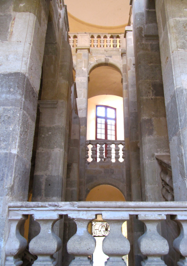
The entrance to the Archbishop’s Palace is located in the Court of Honor of a Medieval fortress building, now the Hötel de Ville, the Town Hall of Narbonne. This interior court, reached by passing through the foyer of the Town Hall, is also adjacent to the cloister and the cathedral that looms over the courtyard. The Great Stairway, built in 1628, stands inside the palace door, and leads to the Musée des Beaux Arts at the top of the stairway. The sumptuous rooms of the Archbishop’s Palace house a collection focused on 17th and 18th century European paintings. The fortifications that surround the courtyard are ancient in origin, and the New Palace was built in several stages. It all began between the years 1290 and 1311, with Archbishop Gilles Aycelin, as he wished to protect his palace and separate himself from the noisy building site of the cathedral. His successor, Bernard des Fargues, archbishop from 1311-1341 added the south and east wings built against the keep. Pierre de Jugie, archbishop from 1347-1375 built the Synod Building. His nephew completed the work of the north wing, overshadow ed by St. Martial Tower. In the 17th and 18th centuries, major changes mitigated the fortified appearance of the Gothic core. The facades around the new palace courtyard were redone in a classical style, the northwest corner was altered, and in 1628 the Grand Staircase was added. Finally, in 1845, the architect responsible for restoring Carcassonne, Viollet le Duc, replaced the east wing and the curtain wall with a neo-Gothic building subsequently used as the Town Hall.
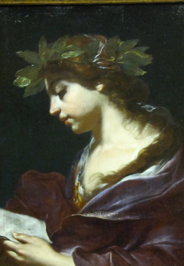
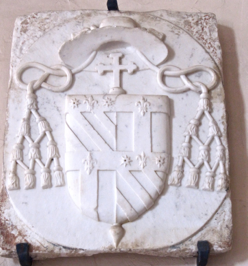
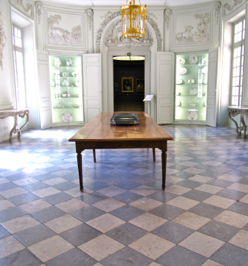
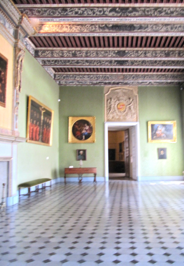
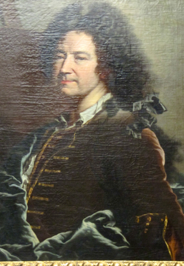
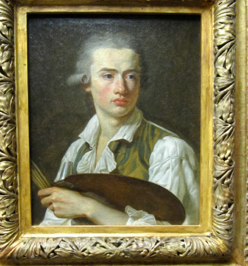
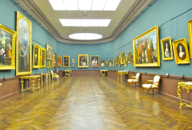
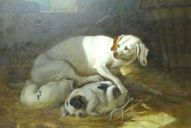
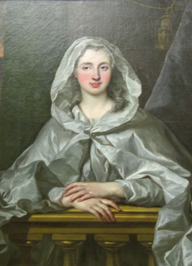
PHOTOS: Left Column: 1. The Great Staircase, c. 1628. 2. Gallery of paintings, the Archbishop’s Palace rooms of the Musée des Beaux Arts. 3. Detail: Jean-Baptiste Oudry (1685-1755) Dog attending her Pups c. 1754.4. Detail: Louis-Michel Van Loo (1707-1771 or 1775) Portrait de Louise Thérese d’Orleans, duchesse de Bourbon. Center, Top: The Archbishop’s Crest, displayed on the Great Staircase of the Archbishop’s Palace. Center, Middle: Archbishop’s Palace gallery exhibiting porcelain within the cabinets of this former dining room. Center, Bottom: Jacques-Louis David (1748-1825) Portrait of a Student of David. Right Column: 1. Detail: Hyacinthe Rigaud (1659-1713) Self Portrait. 2. Entry to the Musée des Beaux-Arts housed in the Archbishop’s Palace. 3. Detail: The Poet. a painting by Brandi, 17th century Italian artist.

Palais des Archevêques & Musée des Beaux Arts