La Cathédral st. sauveur
Aix-en-provence
Provence-Alpes-Côte D’Azur, france
europe
april 16, 2011


La Cathédral st. sauveur
Aix-en-provence
Provence-Alpes-Côte D’Azur, france
europe
april 16, 2011

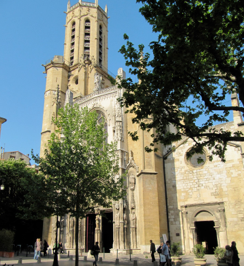
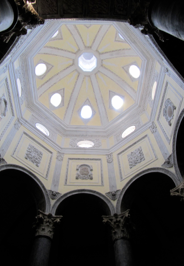
Aix Cathedral, Cathédral Saint-Sauveur d’Aix is one of the principal monuments of Aix-en-Provence. Built on the temple of Apollo, according to the legend, or most likely on a 1st century Roman Forum, the Cathedral developed between the 5th and 18th centuries. The south side exterior of the building has a 12th Romanesque gate adjoining a Roman wall. On the north, a richly carved Gothic gate dates from the 15th and 16th centuries, and is surmounted by a church tower erected between 1323 and 1425. Three naves fill the interior, each of a different style: Romanesque, Gothic, and Baroque. In addition to all these varieties of architectural styles, the Baptistry soars, topped by a Renaissance dome in an octagonal room with paired Roman columns, the foundations dating from a 5th century Christian church. Outside, the Cloister surrounds a garden with delicate columns, dating from the 12th century. With this mixture of architectural styles amassed throughout the centuries, Cathédral Saint-Sauveur’s huge open spaces, soaring ceilings and light wells made it a pleasure to visit. Henry and I took our time exploring the interior and relished the rewards of discovering its many treasures.
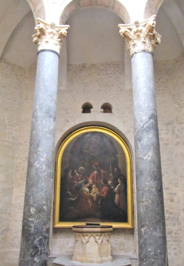
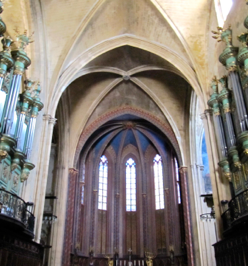
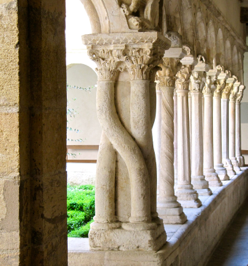
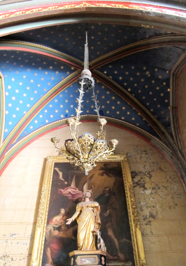
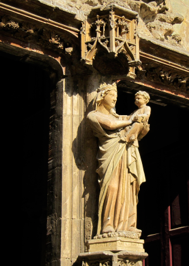
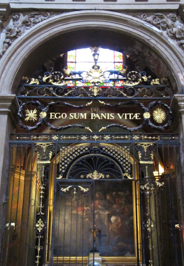
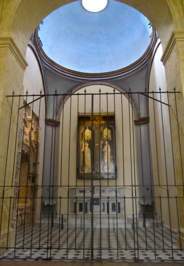
PHOTOS: Left Column: 1. Sculpture between the portal of the Cathédral depicting the Madonna and Christ Child. 2. A side chapel in the cathedral containing a masterpiece of French painting, an altar piece known as Le Buisson Ardent. It was painted around 1476 for King René by Nicolas Froment. On lateral panels are praying donors Jean de Laval to the right, King René to the left in Canon’s robes is surrounded by Saints, one of which is Mary Magdalen, the patron saint of Provence. The exterior of the triptych is done in the Flammant tradition. 3.Ego Sum Panis Vitae meaning “I am the bread of life” are the words on the grille of iron, forged in 1739. The chapel, to the right of the altar, is the Corpus Domini Chapel c. 1666. Center, Top: View of Cathédral Saint-Sauveur d’Aix in Place e l’Université. Center, Middle: View of the nave looking toward the altar. On the right and left walls above the choir are identical cabinets in green and gold. The left cabinet contains an organ replacing an early one dating from 1513. The new organ was built between 1743-46 by Brother Jean-Esprit Isnard, a dominican who built other notable organs in Provence, installed in the cathedral in 1750. An identical but false organ chest was built on the opposite side. The organ has been replaced in the same chest, reconditioned and refurbished in 1855, 1867, ad 1983 respectively. Center, Bottom: View of the Cloister of the Cathédral, built in the 12th century. It’s dimensions are small, covered with solidly built timbered galleries supported by slender, graceful columns. The decorations on the columns include inspiration from the plant, animal and fantasy worlds as well as representing the four evangelists in the gospel. Right Column: 1. Detail: Gothic nave similar in decor to San Chapelle in Paris. 2. Dome of the Baptistry dating from the Renaissance. The original baptistry was built in the 6th resting on an octagonal stand dating to the 5th century. Its central font recalls the ancient rite of baptism by immersion. 3. View of the Renaissance architecture of the Baptistry with its newer version of the baptismal font. Behind the font is a painting entitled Le Baptême c. 1847 by Jean-Baptise Martin (Aix-en-Provence 1880-1904)

A National Monument