Tapestry Museum
Aix en provence
Provence-Alpes-Côte D’Azur, france
europe
april 16, 2011

Tapestry Museum
Aix en provence
Provence-Alpes-Côte D’Azur, france
europe

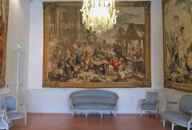
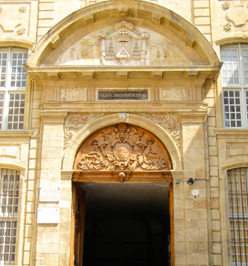
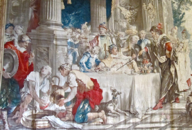
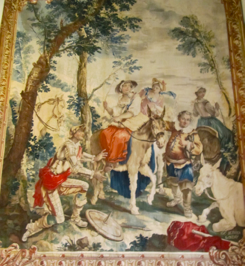
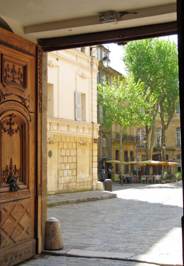
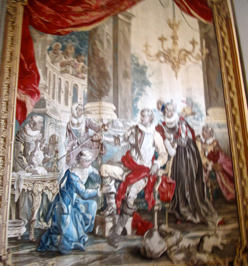
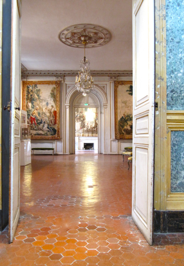
The Musée des Tapisseries or the Tapestry Museum is located in the former Archbishop’s Palace at La Place de L’Archevêché, was built between 1650 and 1730 during the great building project under King Louis XIV. This palace, at the far end of the square, is adorned with an elegant Regency door. Within the building are the sumptuous apartments that were once the residence of the Archbishop in Aix-en-Provence. The building became the Tapestry Museum in 1909, its four wings surrounded by an internal courtyard, now the site of the International Festival of Lyrical Art held every July. Tapestries from the 17th and 18th centuries adorn the walls. A“Grotesque” series, a theatrical decoration woven in Beauvais in 1689, the story of Don Quixote, Russian Games, and other subjects are illustrated in the finely woven tapestries that are intended to mimic paintings. The making of tapestries flourished in Europe from the Middle Ages onwards, at the hands of French, and later Flemish weavers. The growth of tapestry art coincided with the era of Romanesque and Gothic art, both part of a religious revival, where architecture, sculpture, and stained glass were also harnessed by the church to illustrate Biblical stories to the illiterate congregations. By the mid-15th century, as many as 15,000 weavers and other artisans were working in the tapestry centers of the Loire Valley alone. Using either a vertical, high-warp loom or a horizontal, low-warp loom, and a range of no more than twenty colors, medieval weavers produced images of religious stories from the Old and New Testaments. Beginning in 1500 onwards, secular scenes of battle, kings, and noblemen were produced. The Holy Roman Emperor Charles V was typically joined on his military campaigns by an official painter who made drawings for later conversion to preliminary designs (cartoons) for tapestries. Major tapestry-making centers existed at Arras, Tournai, Brussels, Aubusson, Fellitin, and the Beauvais factory in Paris. The finest European tapestries are considered to have been made by the Gobelins Royal Factory in Paris, set up by the French Finance Minister Jean-Baptiste Colbert (1619-1683) in the early 1660’s. Employing more than 1,000 artisans, the factory made more than 2,100 tapestries for King Louis XIV (1638-1715). During the reign of Louis XV, tapestry subjects included scenic landscapes combined with erotic nudes set in classical contexts in the Rococo style. In 1757, a new, faster low-warp loom was invented by Jacques de Vaucanson and enhanced by Joseph Maree Jacquard (1752-1834). Though many of the tapestries were destroyed during the French Revolution, the Beauvais factories were reopened in Paris in 1795, followed by the provincial tapestry centers at Aubusson.
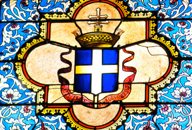
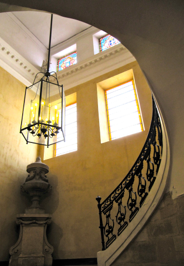
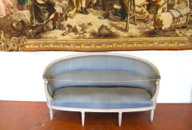
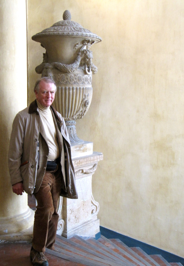
PHOTOS: Left Column: 1. Stained glass window in the stairway of the Archbishop’s Palace. 2. 17th century tapestry, finely woven, its subject matter mimicking painting. 3. A room in the sumptuous apartments of the Archbishop of Aix-en-Provence with furniture dating from the period of Louis XV. 4. A chaise in the style of Louis XV. 5. Henry in the stairway of the Archbishop’s Palace. Center, Top: Regency style doorway leading into the Archbishop’s Palace. Center, Middle: 18th century Don Quixote tapestry. Center, Bottom: Detail: 17th century tapestry. Right Column: 1. View of the stairway in the Archbishop’s Palace. The clearstory windows each have a different pattern of stained glass. 2. View into the apartments of the Archbishop and the tapestry exhibition. 3. View of La Place de L’Archevêché from the doorway of the Archbishop’s Palace.

Le Musée des Tapisseries