GOUDEMALION*
exhibition at Musée les arts decoratifs
paris, france
europe
december 26, 2011


GOUDEMALION*
exhibition at Musée les arts decoratifs
paris, france
europe
december 26, 2011

Jean-Paul Goude is “an artist-cum-precursor, a manipulator of images, by turns, illustrator, artistic director, photographer, and film-maker, as happy as working for the press and the world of fashion as for publicity and advertising campaigns”. Designed as a large installation, the exhibition at the Musée Les Arts Decoratifs brought together drawings, objects, and photographic images in both chronological order and staged settings, tracing Goude’s career over the past forty years. His work has left an impression on the collective imagination beginning with his “minets” in the 1960’s and through his work the following decade at Esquire magazine, from the New York of Andy Warhol and cross-culture to Grace Jones, from his spectacular Bicentenary Parade to advertisements for Galeries Lafayette, Kodak and Chanel. Goude has always succeeded in capturing the spirit of the age and giving it lasting form. The artist’s life and work are inextricably linked, conferring the latter with a particular cachet that lifts it above the imagery. As a teenager, Jean-Paul Goude was fascinated by the big names of the 1950's design, Christian Bérard, René Grau, Tom Keogh, initially placing his own work squarely within this tradition while clearly giving it his own stamp. He worked both for the fashion press and the advertising world, establishing his reputation in 1964 with the vast fresco he created for the New York store Beau Brummel, where his theme launched a new image of youth and masculinity. In 1969, Harold Hayes, managing editor of Esquire invited him to collaborate on the legendary magazine, and he soon became its art director. There, he produced a series of memorable images using well-known political and cultural figures (Richard Nixon, Mohammed Ali) as well as those who would soon be referred to as the "urban tribes" (hispanics, whites, blacks and gays), once again capturing the spirit of the age better than anyone else. Goude's imagination was equally fertile in the presence in the presence of a number of fascinating women whose image he magnified by means of what he referred to as the "French correction", a method of stylizing and transforming bodies, foreshadowing many of today's computer techniques. By disguising, transforming and restructuring, cutting up an increasing number of ektachromes, he brought to life a succession of fabulous creatures, figures from his own personal mythology. Grace Jones, for whom he produced both images and shows, is undoubtedly the most famous of these icons. Back in France in 1982, where, in addition to the traditional forms of expression used in advertising, graphic design and photography, video clips were beginning to be used. Jean-Paul Goude created a series of images and films that have left their stamp on many generations. Aware of Goude's ability to marry the most diverse cultures, President Mitterrand invited Goude to mastermind the parade in honor of the Bicentenary celebration of the French Revolution, a highpoint in his career. In 2001, Goude launched his publicity campaigns for Galleries Lafayette, the posters of which have lined the walls of the Parisian Métro for the past decade. Forever seeking new forms of expression, be it through images for a new perfume or a project for a musical comedy, Jean-Paul Goude continues to write his ongoing "family novel", another chapter begun with this exhibition at the Louvre.
* NOTE: The term Goudemalion was coined by Edgar Morin, French philosopher and sociologist, to describe Jean-Paul Goude's ability to transform his fantasies, which revolved around the imponderable nature of female Beauty, transmuting them into myth. The term refers to the legend of Pygmalion, a legend about a king of Cyprus who sculpted a statue which, having been imbued with life by Aphrodite, he succeeded to wed.
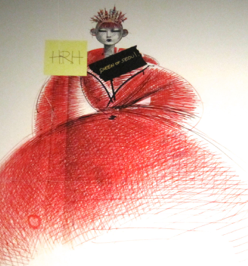
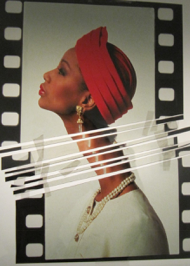
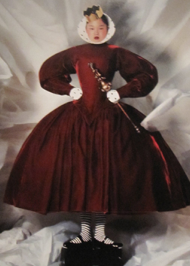
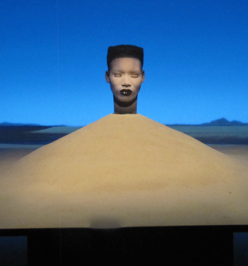
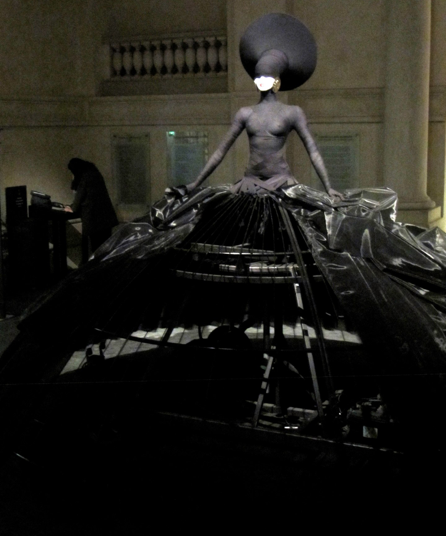
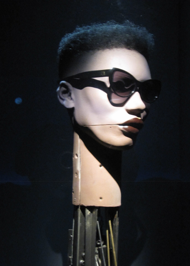
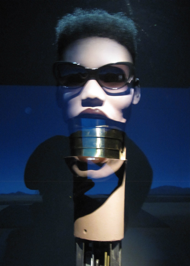
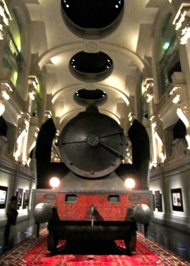
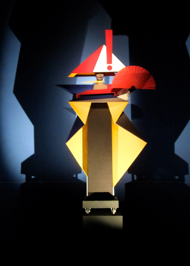
PHOTOS: Top Two: 1. A mechanical mannequin of unusual proportions: at least 12 feet tall, ultra thin, the skirt raised to reveal the mechanical underpinning that allows her to turn 360 degrees. This image greeted each guest who enters the exhibition. 2. And, if you haven’t seen the true spectacular, the next installation is an enormous train that fills the full length of the main gallery. This “iron horse” marvel stands incongruously on top of a splendid oriental carpet spread the length of the plinth. The train was part of the Bicentenary Parade on the Champs Elysée in Paris in 1989. Creatively costumed marchers representing every culture and country entertained the dignitaries gathered for this event celebrating the French Revolution. Middle Three: All images celebrating the pop star, Grace Jones. The centerpiece is Grace Jones in sand, her robotic eyes open and close, when opened bright lights emanate from her eyes. The two robotic heads on the far right are a 3-D portrait of Grace Jones. Her mouth opens and the jaw expands to expose several rows of metal “teeth”. Bottom Three: 1. Fashion photograph 2. Drawing with the note HRH and penciled in “the Queen of Seoul”. 3. Jean-Paul Goude’s “French Correction”, cutting up ektachromes he elongated the neck of the model, a precursor to computerized technology enhancing fashion photos for advertising purposes.

A Retrospective of Jean-Paul Goude
11 November 2011 - 18 March 2012