ornate palace rooms
MUNICH RESIDENCE • RESIDENCE MUSEUM
MUNICH, GERMANY
europe
JANUARY 21, 2011


ornate palace rooms
MUNICH RESIDENCE • RESIDENCE MUSEUM
MUNICH, GERMANY
europe
JANUARY 21, 2011

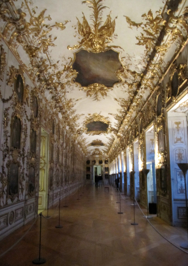
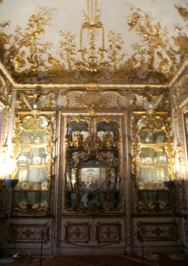
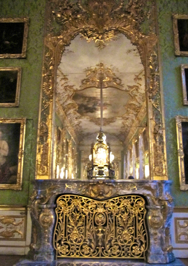
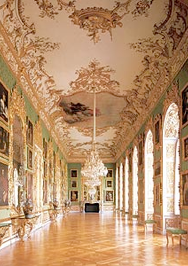
The sumptuous Rococo rooms of the Residenz, referred to as the Reiche Zimmer or the Ornate Rooms were designed and furnished for the Elector Karl Albrecht, Emperor Karl VII, between 1730 and 1733. These state apartments were designed by the French architect, François de Cuvillés, who also designed the court theater located in one of the courtyards of the palace. The floor plan, the carved wall panelling, the ceiling stucco, and the furnishings were all the work of the architect, whose interiors are not only unique, but are also considered to be a work of art in their own right, further embellished by precious textiles and highly crafted and expensive furniture imported from Paris. The rooms consist of the following:
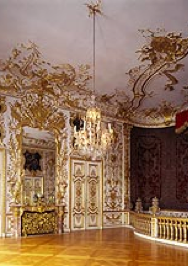
•The Audience Chamber is the room where envoys were granted audience in the presence of the entire court. The Elector received his guest standing beneath a red velvet canopy and in front of a chair placed on a dais covered with a carpet. The walls of this room and the two other antechambers in the Reiche Zimmer are hung with Genoa silk consisting of red relief decoration on a gold ground.
•The Green Gallery or Grüne Galerie is the place where splendid gatherings took place twice a week, with selected members of the court invited to attend. On these occasions, the gallery and the adjacent rooms in the sequence of Ornate Rooms were bright lit with the light from hundreds of candles, their reflections cast in the large mirrors and gilding on the walls. The name of the room is derived from the green silk damask that covers the walls. Between the mirrors were hung important unrivaled masterpieces, each framed with the gilt Rococo architecture, three paintings high. The works of art were from the extensive collections of the Wittelsbach family, some of which now hang in the Alte Pinakothek
•The Conference Chamber was a “Secret Chamber” reserved for political conversations or private conversations within the family of the Elector, Karl Albrecht. Only persons of the the highest rank or members of his immediate family were permitted to visit him in this intimate cabinet. Because this room occupied a more important place in court etiquette than the other reception rooms in the Reiche Zimmer, its stucco, carving, and furnishings were even more elaborate.
•The State Bedroom or Reiche Zimmer The bedroom was a room for display only, in which the Elector Karl Albrecht followed the fashion of the French court. Unlike the French kings, whose court attended the monarch’s rising and retiring (i.e, Petit and Grand Lever, and the Petit and Grand Coucher), the German emperor’s bedroom was simply used as background for the assembly of members of the court. To mark its importance, the state bedroom was furnished with particularly lavish and expensive items of furniture. Elector Karl Albrecht commissioned this lacquered furniture from the Paris cabinetmakers Bernard Vanrisamburgh and Antoine-Robert Gaurdreaus.
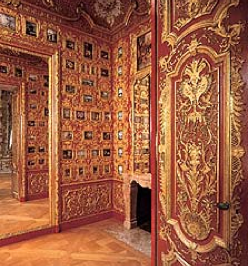
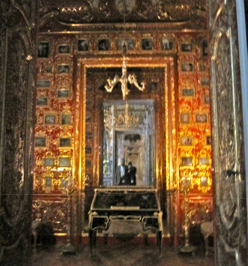
•The Miniature Cabinet or Miniaturenkabinett was one of two small chambers adjoining the State Bedroom, one of which was intended for writing and relaxing, the otyher as a cabinet of mirrors and porcelain. Since large mirrors were expensive in the 18th century, the cabinet is an ostentatious example of wealth and opulence, containing a collection of 129 miniature paintings by Dutch, French and German painters, c. 16th - 18th century, encased within the paneling. The ever-changing reflections also offer a variety of views of the lavish gilt carving and stucco on the surfaces of the room. The mirror in the Miniaturekabinett is aligned with the mirror at the end of the Grüne Galerie to give the illusion of an infinite sequence of rooms stretching in both directions.
Adjacent to these extraordinary rooms are chambers representing the Baroque era, erected by Ferdinand Maria (1651-1679 including the Ancestral Gallery and the Porcelain Cabinet, both constructed by Joseph Effner.
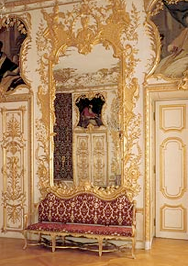
PHOTOS: Left Column: 1.The Grüne Galerie or Green Gallery, designed by François de Cuvillés, c. 1730-1733. Paintings by famous German painters were displayed in architectural Rococo frames hung three high between framed mirrors, installed on green silk walls. 2. View of the marble fireplace mantel, its mirror and elaborate screen, all designed by the French architect, Francois de Cuvillés. 3. The Conference Chamber of the Reich Zimmer, where Karl VII conducted his private conversations with his family or members of his court who held the highest rank. Center, Top: View of the Miniature Cabinet with its writing desk. Center, Middle: A painting of Karl Albrecht, Emperor Karl VII, by George Desmarées, workshop, after 1742. Center, Bottom: A view of the Miniature Cabinet with its large mirrors and framed paintings on Japanese lacquer paneling. Right Column: 1. Porcelain Cabinet, a Baroque era gallery by Joseph Effner, c. 17th century. 2. The Ancestral Gallery of Ferdinand Maria (1651-1679) by Joseph Effner, c. 17th century. 3. The Reiche Zimmer or State Bedroom, a ceremonial room designed for the Elector Karl Albrecht between 1730-1733.

Rococo Interiors