The Church
Meersburg-am-bodensee
Baden-Württemberg, GERMANY
europe
february 3, 2011


The Church
Meersburg-am-bodensee
Baden-Württemberg, GERMANY
europe
february 3, 2011

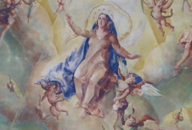
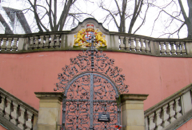
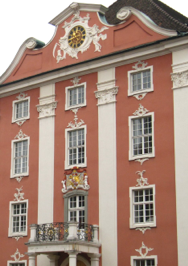
There are two religious sites Henry and I visited on our day in Meersburg. The first was the Parish Church on the upper terraces of the city, near the villa in the vineyards where we stayed in 1994. At that time, the bells in the tower of the church chimed every quarter hour for 24 hours a day. It was almost impossible to sleep with thousands of new German words dancing across my brain, and I never became accustomed to being awakened by the bells. Out of pure exhaustion or disinterest, I never visited the church during that period. This time, I was amazed to find a simple exterior, dominated by the bell tower that now only chimes between 7 AM and 10 PM, a nice correction cleverly negotiated by stopping the bells for a period of time as “broken”, then re-activating them on the new schedule. This is what we were told in 1997 when we re-enrolled at our German-language school for an additional two-week course. The history of the church is interesting, as Meersburg played a significant role during the Reformation in 1520, after Konstanz declared itself officially protestant. Paintings were removed from the churches there, and the bishop temporarily moved to Meersburg. At the end of the Thirty Year’s War in 1648, followed by the counter-reformation instigated by the Catholic Church, an explosion of building works took place in the region known as Upper Swabia*. Immigrants to the depopulated areas of Upper Swabia contributed to the economic upturn, which made it possible for the owners of the smallest villages to secure funds to restore, extend, and enhance the existing buildings in the Baroque style. Monasteries, secular buildings, commercial buildings and castles were included in this building boom that lasted from 1650 until the French Revolution in 1789. The result is a style in the region known as Upper Swabian Baroque. Meersburg, because of its position on the northern bank of the Bodensee, became the terminator point between the western and southern Upper Swabian Baroque route. The Neues Schloss or New Castle was built in several stages under the guidance of several Prince-Bishops, beginning in 1710. In 1750, a new palace designed by Balthasar Neumann was built. The site of this second castle in town is located on a hill over Lake Constance. There is a garden terrace with excellent views of the lower city of Meersburg, accessible through either the castle or or through a wrought-iron gate at the bottom of a stairway leading to a terrace. On the town side, the castle stands on a large plaza, the Schlossplatz. In the center of the castle façade is a large clock with the god of time, Chronos. On the left side of the castle is the entrance to a baroque-style chapel used by the Evangelical Church in Germany. During the re-organization of Europe under Napoleon at the beginning of the 19th century, Imperial Abbeys, the Free Imperial Cities, and the territories ruled by Imperial Knights lost their independence and their income. Many buildings were converted into barracks, schools, psychiatric hospitals or even manufacturing sites. Beginning in the 20th century, efforts were made to restore and save these architectural treasures. When we visited Meersburg this time, the New Castle, now a museum, was closed for restoration, with completion of the project slated for 2012.
*Upper Swabia is one of the natural regions of Germany on the Iller-Lech Plateau in south-central area of the country. It consists of southeastern Baden-Württemberg and southwestern Bavaria. The landscape was formed by retreating glaciers leaving behind shallows that filled with water. There are many lakes in the region, including Lake Constance. The hilly landscape is a European watershed with rivers emptying into Lake Constance, and ultimately ending up in the Black Sea.
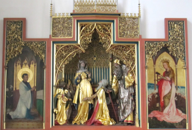
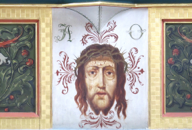
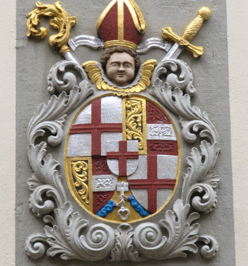
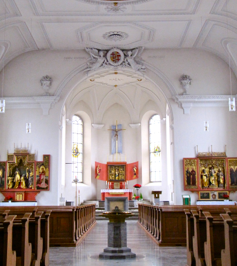
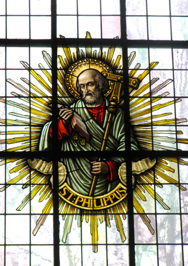
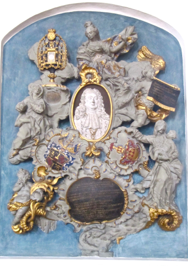
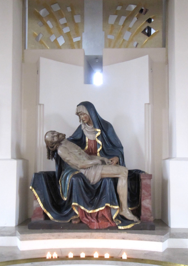
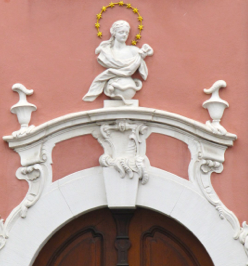
PHOTOS: Left Column: 1.The stairway and balustrades of the garden of the New Castle, the Bishop’s Palace.c. 18th century. 2. Ceiling fresco, the Ascension of the Virgin in the Parish Church of Meersburg-am-Bodensee. 3. The three-part altarpiece at the Parish Church. 4. Detail: altarpiece with Christ Crowned with Thorns. 5. Piéta opposite the altar in the Parrish Church. Center, Top: Bishop’s coat-of-arms. Center, Middle: Detail: Baroque plasterwork above the doorway of the New Castle, the Bishop’s Palace in Meersburg-am-Bodensee. Center, Bottom: Altar of the Parish Church in Meersburg-am-Bodensee. Right Column: 1.Detail: façade of the New Castle or the Bishop’s Palace, designed by Balthasar Neumann in the 18th century. The clock with Chronos is in the center of the façade. 2. Stained glass window of St. Phillip in the Parish Church. 3.Elaborate 18th century plasterwork memorial in the Parish Church.

Neues Schloss & Parish Church