emigration & LIFE in America
seesen to New York City
Lower Saxony to america
1850


emigration & LIFE in America
seesen to New York City
Lower Saxony to america
1850

To America !
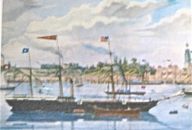
In the mid-19th century, the economic situation in Germany became more difficult for Heinrich Engelhard Steinweg. Crop failures led to price increases, and the 1848 Revolution paralyzed trade. In addition, a tariff union amongst south-German states, of which Seesen belonged, made it barely profitable to sell the instruments beyond the confines of the union. Son Karl’s involvement with the uprising in the Duchy of Braunschweig is likely also to have played a part in the decision to emigrate. To protect him from possible reprisals, his parents sent him to America. Perhaps it was Karl’s letters home to his family in Germany that encouraged their decision to emigrate. On March 20, 1850, the Steinweg family listed an Emigration Announcement in the weekly newspaper of the Gandersheim district, a formality in Germany to apprise fellow citizens of their intention to leave the area. The Steinweg family sailed on the first German steamboat to cruise the ocean, the Helena Sloman. The passenger list, from the Hamburg archives, listed the Instrument manufacturer, Steinweg from Seesen, his wife and children in the penultimate line. After a five week crossing (advertised to be only three weeks, but slowed because of technical difficulties) the ship and its passengers arrived in New York on June 28, 1850. When the family arrived, Karl Steinweg had already researched the possibilities for a piano manufacturing business in America. Upon arrival, the Steiweg family settled in a house on Hester Street in lower Manhattan. All the male members of the family worked in various piano factories, using their skills and mastering English. The family’s eldest son, Theodore, remained in Germany and took over his father’s business there. Three years after arriving in America, Steinway and Sons was founded in 1853, opening its first showroom and factory on Varick Street in New York City, later to move to Park Avenue, then to Fourteenth Street and later to Astoria, Queens. The Steinway daughters were also actively involved in the business, promoting pianos by giving piano lessons. The eldest son, Theodore, continued manufacturing pianos in Germany and opened a factory in Hamburg as early as 1880. Even after their emigration, the Steinway family maintained its links with the town of Seesen. William, in Particular, provided generous support. In 1888 he was made an honorary citizen. Sessen’s spa garden, laid out in 1892, were named after him.
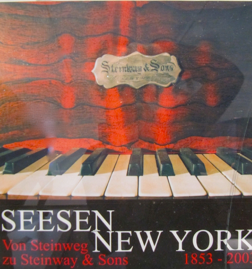
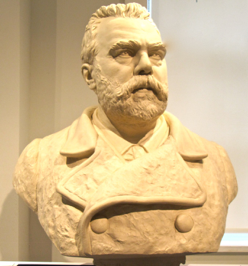
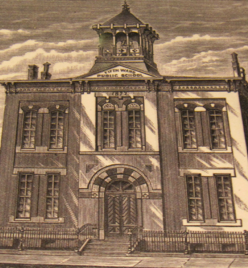
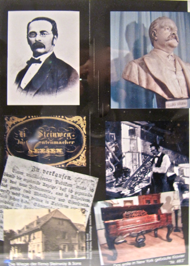
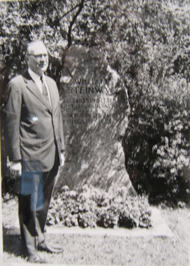
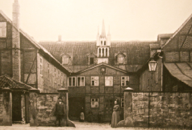
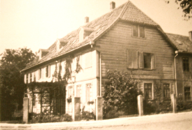
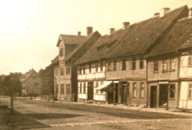
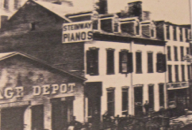
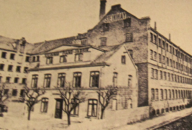
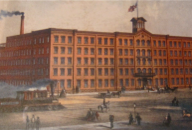
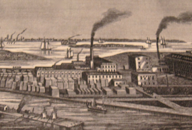
PHOTOS: Left Column: 1. The Steinweg family home in Seesen, 1825-1850. 2. The workshop and manufacturing facility of Steinweg Piano. The tile roof of the house facing another street is visible in the background. During that time, it was a German custom to live and work on the same property, or at least nearby. When the Steinweg family left Seesen, the factory was sold and became an orphanage. 3. View of the family house as seen from the street in Seesen. 4. Steamboat Helena Sloman, photograph from the Städtisches Museum is a reproduction from an original by Robert M. Sloman, Jr., Hamburg. 5. Henry Ziegler Steinway (1915 - 2008)* He is shown standing beside a monument to William Steinway.*1 Center, Top: Steinway School, located on Steinway Avenue in Queens, New York. Considered to be a model of its kind, this stately edifice had room for 500 school children and had extensive playgrounds attached to it. The children of workers in the Steinway factory in New York were taught an English curriculum, and in addition were offered free courses in music and the German language. Center, Middle: A poster celebrating 150 years of Steinway Pianos linking Seesen and New York. Center, Bottom: Detail: a pedestal bust of William Steinway.* Right Column. 1. The second Steinway Piano factory in New York City, located on 14th Street. When the family outgrew their first workshop c. 1853, in the attic premises on Varick Street, they took over the production factory of another piano-making firm, until these were no longer big enough. 2. The third New York City factory: Steinway & Sons at Fourth Avenue between 52nd and 53rd Streets. This same land now hosts the Seagram’s building, designed by Mies van der Rohe in the International Style, completed in 1958. Fourth Avenue is now known as Park Avenue, NYC. 3. The fourth and final factory: Steinway & Sons Piano Case & Action Factory, Foundry, Metal Works, Drying Kilns, Saw Mill and Lumber Yard at “Steinway” in Astoria, Queens, opposite 120th Street, New York City. This is the factory where Steinway & Sons pianos are produced to this day. 4. Steinway & Son’s Hamburg factory, 1880 reproduction courtesy Städtisches Museum, Seesen. 5. A Collage of memorabilia from the Städtisches Museum, Seesen. This storyboard of information was assembled by the museum to honor the 150th anniversary of Steinway & Sons in America, with its foundational roots in the town of Seesen, Lower Saxony, Germany.
*Henry Ziegler Steinway, great-grandson of Henry Engelhard Steinweg, founder of the company. (not to be confused with my husband, his first cousin Henry Steinway Ziegler) “Hank” served as President of Steinway & Sons 1955-1972, when he sold the company to CBS. In 1977 he was then made Chairman of the company. He retired at the age of 65 in 1980, but continued to go to his office at Steinway Hall most days, serving as good-will ambassador, until only a few months before his death in 2008.
*1 Of all the members of the family, William Steinway retained the closest links to his home town of Seesen. From 1868 he visited the town whenever he could. His friendships there and his interest in the development of the town led to his financial engagement as well. William Steinway donated a grand piano to the Jacobson School, and a number of organizations received grants. He supported not only the poor but the best pupils in town. Steinway was particularly generous when the park was laid out. Work began in 1892, and the town named the park Steinway Park after its benefactor. In 1888, William Steinway was made an honorary citizen in return for his generosity.