steinway piano exhibit
Städtisches museum, seesen
Lower Saxon, northern Germany
europe
October 5, 2011


steinway piano exhibit
Städtisches museum, seesen
Lower Saxon, northern Germany
europe
October 5, 2011

The Steinway Rooms of the Stätishes Museum in Seesen recounts the history of the Steinway piano as follows:
“Heinrich Engelhard Steinweg’s self-confidence was bold enough to attempt a fresh start in New York in 1850 at the age of 53. Initially he and his sons worked for various piano makers to learn about American habits in their trade. In 1853 they founded Steinway & Sons. They hoped the Americanized name would lead to better business. Until 1864, however, the family itself retained the name Steinweg. Because of their skills, inventiveness and the huge demand, Steinway & Sons soon succeeded in establishing itself amongst the top piano makers. Before long they needed new, larger workshops and offices. In addition to its production locations in Manhattan, Steinway also built its own district, Steinway, on Long Island. Beginning with the company’s founding in 1853, Steinway & Sons was dedicated to the aim of building “the best piano possible”. With ambition and technical skill, the Steinway family built up a world-famous company in New York. Steinway & Sons has revered its history and the patents and methods developed over the course of more than 150 years, developing the world’s finest piano. Though no artist or ensemble is paid to endorse the piano, more than 1,500 prominent concert artists and ensembles across the world bear the title “Steinway Artist”. Each of these artists personally owns a Steinway and has chosen to perform on the Steinway piano professionally. The Steinway remains the choice of 9 out of 10 concert artists, and is the preferred piano of countless musicians throughout the world. Ninety-eight percent of all concerts worldwide are played on a Steinway piano.”
In the Städtisches Museum in Seesen, one of the exhibition rooms has statements and signatures from some of the world’s most prominent artists who attest to their love of the piano. For example, the following quotations appear in the Steinweg wing of the Státisches Museum, Seesen:
•“Der Hamburger Hause Steinway, der alter, treue Freund und Bewunderer”. TRANSLATED: The Hamburg House Steinway, an old, true, and admirable friend. Arthur Rubenstein, September 30, 1963
•“If I am to play my best, there is no way but Steinway!” Lang Lang, December 10, 2003
•“Dem Engelsteufel Steinway meine Recouvez!” TRANSLATED: That Impish Steinway, my salvation! Alfred Brendel March, 2004
•“Der Hamburger Hause Steinway mit Bewunderung und Dankbarkeit.” TRANSLATED: The Hamburg House Steinway with admiration and gratitude. Daniel Barenboim 9 December, 2005
• “Das Steinway, wattdenn sonst?” TRANSLATED: The Steinway, what else? Christian Zacharias
•“My Hamburg Steinway ‘C’ is my favorite piano for my favorite piano for composing music. It sings to me every time I play it.” Billy Joel
•“Steinway ist für mich immer wieder the greatest!” TRANSLATED: Steinway is for me always the greatest! Lars Vogt
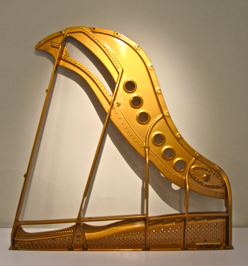
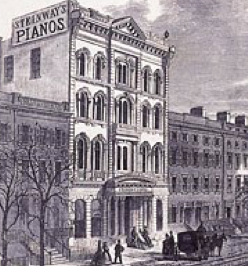
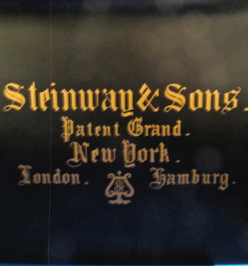
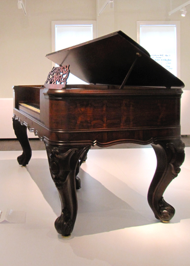
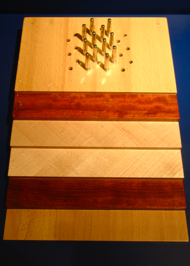
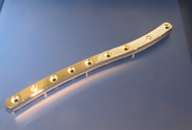
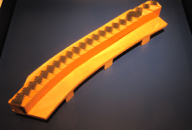
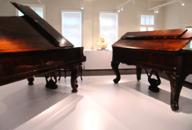
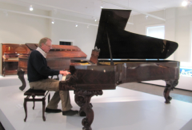
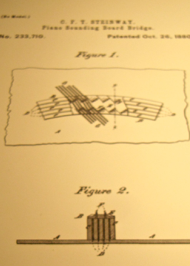
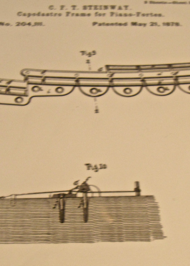
PHOTOS: Top Four: 1. Steinway Patent Nr. 233.710 “Piano Sounding Board Bridge”, C. F. Theodor Steinway, 1880. The sounding board bridge transmits the vibrations of the strings to the sounding board. The patent describes a new form of bridge construction. It consists of upright layers of glued wood. The new construction method increases the intensity of the vibrations and means they can be transmitted better. 2. Steinway Patent Nr. 204.111: “Capodastro Frame for Piano-Fortes”, C.F. Theodor Steinway, 1878. Steinway & Sons, Hamburg. The patent for the Capodastro describes the triplex scale for pianos and is based on the duplex scale patent for Steinway grand pianos. In the duplex or triplex scale the length of the string which vibrates is in a certain proportion to the dead end of the string between the peg and the bridge. The resonance makes this end vibrate in harmony and thus contributes to the brilliance of the sound. 3. Cast-iron plate for a grand piano Model M-170, 1998. Cast-iron, painted gold, Loaned to the Städtisches Museum Seesen by Steinway & Sons, Hamburg. 4. “Wrestplanks” Steinway and Sons, Hamburg. Patent No. 3.091.149, dated 1959. The pegs are set in the wrestplank; one end of the peg is attached to the string. The pegs are turned to tighten and tune the string. The wrestplank is so constructed that it will maintain the pitch as long as possible. To achieve this, Steinway uses six layers of hardwood glued to each other. The grain is turned through 45 degrees each time so the peg can retain a particularly firm grip. Middle Three: 1. Detail: Drawing for the “Capodrastro Frame for Piano-Fortes”, Steinway Patent Nr. 204.111 by C.F. Theodor Steinway, 1878. 2. The Steinway & Sons piano mark for pianos made in Hamburg. Steinway New York is responsible for instruments delivered to North and South America, while Hamburg is responsible for instruments delivered to the rest of the world. 3. Reproduction of a drawing for a Steinway patent for a Sounding Board Bridge by C.F. Theodor Steinway, 1880. Bottom Four: 1. Henry playing on a Steinway & Sons, No. 8910, manufactured in 1864. The piano dates from the early years of Steinway & Sons. A Hamburg family bought the piano in 1864. Many of the patents by Henry, Jr. and Theodor Steinway were used in this instrument such as the cross-stringing and the improved cast-iron frame that withstands the enormous tension of the strings. In 1958, the piano was given to the choir Eintracht 1844 Seesen, of which William Steinway was an honorary member. In 1992, the instrument was given to the town but continued to be used by the choir until it was disbanded in 2004. 2. Display of two of the three pianos in the Städtisches Museum in Seesen. At the center background of this photo is the bust of William Steinway. 3. Steinway Hall, the first concert hall in New York City, built on 14th Street at Union Square by the Steinway family. It had a capacity of an audience of 2,500. The hall was destroyed in 1925 when Steinway & Sons opened its new showroom on 57th Street. 4. Square piano by Steinway & Sons No. 483, 1853. In America, Henry Engelhard Steinway continued the method of counting the instruments that he had begun in Germany. The first piano built in America was given the number 483. Steinway & Sons sold it to a New York family for 500 dollars. It was later displayed in the Metropolitan Museum of Art before being transferred to the museum in Seesen in 1996. It is on loan to the Städtisches Museum from Steinway & Sons, New York. This is the first piano to have the mark Steinway & Sons.

A Legacy to Build the Best Piano Possible