Knosssos Palace
BETWEEN THE CRETAN SEA & THE LIBYAN SEA
HERAKLION, CRETE, GREECE
THE HELLENIC REPUBLIC
SOUTHEASTERN Europe
OCTOBER 9, 2008


Knosssos Palace
BETWEEN THE CRETAN SEA & THE LIBYAN SEA
HERAKLION, CRETE, GREECE
THE HELLENIC REPUBLIC
SOUTHEASTERN Europe
OCTOBER 9, 2008

The Minoan Civilization is best envisioned by a visit to one of the four large palaces discovered by archaeological excavations, the best of those being at Knossos. These palaces have architectural features in common, including: multi-level buildings arranged around a center court, all connected by interior stairways and light wells, monumental entrances, façades of closely fitted poros stone blocks, sacred rooms, and a large number of magazines, or store rooms. These palaces also contained workshops which produced the most decorative style of pottery in the world, plus fine vessels in stone, figurines in faience, and sealstones of precious and semi-precious stones. Bronze weapons, finely, created jewelry in silver or gold, vases shaped with technical precision, and charming miniature sculpture were made here. The story of the Minoans, named after King Minos, legendary king of Crete, lasted 1500 years, between 2600 and 1100 B.C.. The population of the island, favorably located for the Minoan domination of the sea, came from three continents: Europe, Asia, and Africa. The blend of these racial types is evidenced in the skulls found in the excavations, and produced a “Mediterranean type” of medium height, with black curly hair and brown eyes. Homer writes of the people who lived on Crete as being members of various tribes, each with its own language. There were 90 cities in Crete at one point; and, in the Second Palace period (1700-1350 B.C.) boasted large palaces built on the ruins of the First Palace period centers (1900-1700 B.C.), which were destroyed by earthquakes around 1700 B.C.. The resurgent civilization became more organized, with harbors, trade by fast ships, sophisticated farming, a network of roads, expanded cities, rural villas and local governors. Each palace had a king who was also the religious leader, commanding a theocratic state. It is thought that this theocracy had a hierarchy of leaders, with the king of Knossos as the supreme leader. A peace pact, the Pax Minoica, united the island and supported prosperity, cultural development, a charming lifestyle and the thalassocracy of Crete. Around 1450, all the palace centers of Crete were destroyed by the volcanic eruption at Santorini, with only the palace at Knossos resuming life. The Achaens (possibly from Mycenae) moved in, building the simple megara on the palace sites. The basis of this new Post-Palace period (1350-1100 B.C.) was Minoan, but it was Archaic Greek in spirit. Culture, expressed in art, was more systemized and repetitive, with more rigidity and a loss of freedom and vigor. The final demise of the Minoan culture, according to our guide book, came with the arrival of “massive waves of Dorians” around 1100 B.C.. The years dating 1100-1000 B.C. have been categorized as the Sub-Minoan period. In the intervening centuries, this Greek Island has been occupied by Turkey. A lawyer who lives on Crete brought us up to date by letting us know that there are no “Cretans” left on Crete, except a few dark-skinned, blue-eyed people in the north. Most everyone, who now lives on Crete, he admitted, is a blend of Greek and Turkish. I mourn the loss of the Minoan culture: an ancient, intelligent, peaceful, charming, and creative civilization, where all the images depicting its people, depict them with smiles. The Archaeological site and ruins of the Palace of Knossos sits just south of the city of Heraklion, a mere 15 minute drive from the harbor. It was easy to find, and fascinating to visit. In fact, a visit to Crete would not have been complete without venturing here. Henry and I drove, parked in a nearby olive grove, flagged in by the owners of a café. They asked for no money, just a promise to have a coffee at their restaurant a bit later. We had our taste buds set on coffee at “Yum Yum” nearer town, and paid them the going rate of 2 euros to exit at the end of our tour. The line for the tickets moved quickly, and soon enough we were studying the guide book to plan our self-guided tour. The site was well-marked, with good signs in Greek and English, which explained each important part of the palace. We spent over two hours walking around the entire site, the ruin of a palace, which would have been 22,000 square meters in size, with 1500 rooms at its zenith. We even sat on a rock, taking a sort break to photograph a stately peacock. Then, we were off on our drive along the north coast of Crete to a point past Chania. Our plan was to have a good rest and swim in the Cretan Sea at a tiny, isolated taverna-with-rooms called “Waves on the Rock” at Ravdoucha Beach.
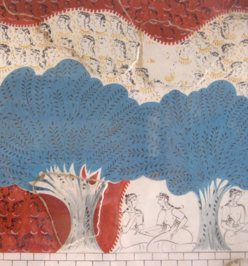
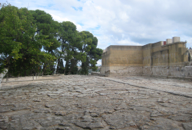
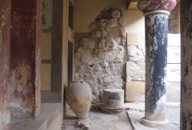
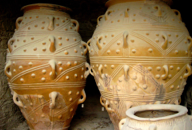
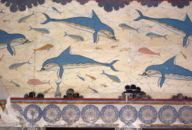
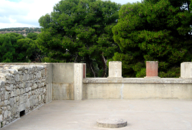
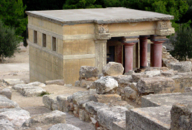
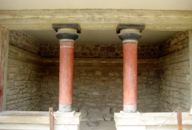
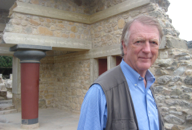
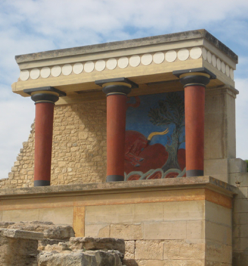
PHOTOS: Left Column: 1. Henry, standing before the “West Porch, Corridor of the Procession”. This 2. The House of the Chancel Screen. This area was part of the New Palace Period (1700-1450 B.C.) This has been partially restored. A bench which held some object of religious worship would have been placed behind the columns. A paved hall with a double tier and door partition would have been in front of this area. 3. West Court, the entrance to the Palace. This area is paved in large stones, with a raised pathway or “processional” which leads to the palace complex. 4. Queen’s Megaron, in the East Wing of the Palace. It is especially interesting because this area reveals two stories of the building and is richly decorated with beautiful frescoes. Found here were fragments of a clay bath, interpreted by the archaeologists to indicate that bathing and preparation rituals were performed here, in this space considered to be the queen’s bath. Center, Top: North Entrance, North Pillar Hall. This is the “Bastion” reconstructed by archaeologist, Arthur Evans. He placed a restored relief fresco of a bull here, which may have formed part of a hunting scene. Center, Bottom: Detail, wall fresco. This is a copy of a wall fresco found at the Palace of Knossos, displayed in the “Hall of Fresco Copies” at the palace. Right Column: 1. Giant pithoi in a Magazine of the Giant Pithoi. This was one of a series of small storage rooms which held these huge jars (pithoi), each over six feet tall. They are distinguished not only by their size, but also by their numbers of handles and the relief decorations of ropes and discs. 2. Detail, dolphin wall fresco found in the Queen’s Megaron. 3. Tripartite Shrine with a facade of columns, divided into three parts with the center, the highest part of the shrine. 4. North Lustral Basin. This is a small building with a sunken floor, reached by steps. It is surrounded by columns with a slab of gypsum to give it a luxurious appearance. These were thought to have been used for purification ceremonies, used by visitors entering the palace from the nearby North Entrance. This type of building has been found in other parts of the Palace of Knossos as well in important Minoan Buildings built between 1700 and 1450 B.C.

The Minoan Civilization