paros archaeological museum
PARIKIA, PAROS, CYCLADES ISLANDS
THE AEGEAN SEA, GREECE
THE HELLENIC REPUBLIC
SOUTHEASTERN Europe
September 22, 2008


paros archaeological museum
PARIKIA, PAROS, CYCLADES ISLANDS
THE AEGEAN SEA, GREECE
THE HELLENIC REPUBLIC
SOUTHEASTERN Europe
September 22, 2008

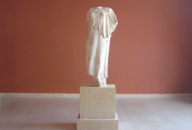
The Paros Archeological Museum is considered to be the most important museum in the Aegean Sea, housing numerous examples of sculpture dating to the Archaic and Classical periods, some of which was made from marble quarried on the island of Paros. The museum houses many artifacts that also date from the Late Neolithic Period, 4,000-5,000 B.C., found on a the tiny island of Saliangos, between Paros and Antiparos. Late Bronze Age finds on Paros,near the sea include Early Cycladic marble figures, bronze tools, and terracotta vases. Two Prehistoric settlements have been found on Paros: one, on Kastro Hill near Parikia, the other on Koukounas Hill on the north side of the island near Naoussa. These two settlements, dating between 1000-800 B.C. in the Geometric Period, have yielded excellent examples of vases and miniature art. Around 700 B.C., a famous school of sculpture began to emerge on Paros, where the superb, white Parian marble, lychenites, was carved. Two important artists of the time included Agorakritos and Skorpas. It was during the Archaic Period (700-500 B.C.), that Paros flourished culturally. The sanctuary of Delios was built on the north side of the city. In the 4th century B.C., the sanctuary of Asklepios was erected to the south of Parikia, with building continuing throughout the Hellenistic and Roman periods. On the east side of Parikia, three archaeological finds include: a sculpture workshop, a pottery workshop, and a house constructed during the Roman Period. The following works are considered to be treasures in the Paros Archeological Museum:
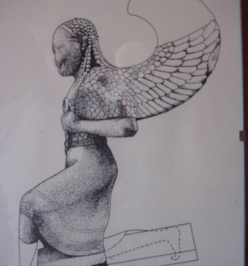
•A 6th century B.C. Gorgon, carved of marble, which was the central akroterion on the pediment of a temple. During this period, this fierce, winged monster was commonly incorporated into city walls, used on warrior shields, and represented a terrifying Medusa image, which myth describes as “petrifying the viewer at once”. Gorgon was the mortal daughter of the sea deities Phorkys and Keto, lived in the west beyond the ocean, and had two immortal sisters.
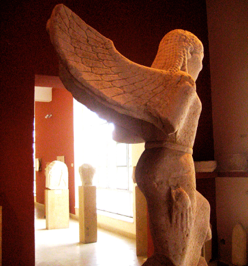
•A 5th century, B.C. Nike, carved of marble, depicted while still in flight with one foot set on the earth, giving the impressions she is still hovering.
•3,000 B.C. Early Cycladic marble figures and vases.
•1,500 B.C. Mycenaean period vases.
•600 B.C. Geometric period amphoras
•100 B.C. Marble slab with the Parian Chronicle, a record of important historical and literary events which date from 1581 B.C. to 264 B.C. The first of two fragments, were taken to London in 1627 and were given to the Ashmoleon Museum at Oxford University in 1667. The second is in the museum in Paros.
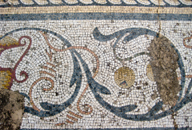
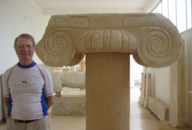
The courtyard of the museum has numerous stele and sarcophagi and artifacts from cemeteries , two examples of mosaic floors, and many columns, some dating from the Ionic period. It was well worth re-arranging our day to visit the museum before the 2 PM daily closing.
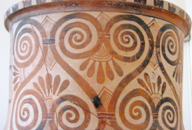
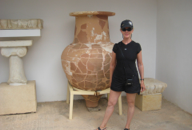
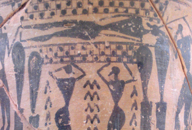
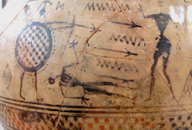
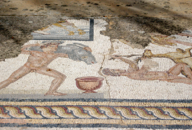
PHOTOS: Left Column: 1. Detail: mosaic floor. 2. Nike, 5th century B.C. 3. Jourdan standing beside an enormous reconstructed amphora. 4. Detail: 7th c. B.C. Geometric period amphora. The neck of this clay vase is decorated with the depiction of a funeral. The corpse is horizontal at the center, a figure (on the right) pulls a spear from the neck of the dead man. Two figures in the foreground mourn the death. Center Top: Gorgon, carved marble, 6th c. B.C. Center, Bottom: Drawing, depicting the Gorgon as it would have appeared in the temple. Right Column: 1. Detail, mosaic floor. 2. Detail: Cycladic Amphora vase from Parian workshop, c. 7th century B.C. 3. Henry, standing next to an Ionic capital, with inscriptions relating to the death of the first lyric poet born in Paros in the early 7th century B.C. This would have been included in a memorial monument or Archilocheion commemorating the poet, Archilochos, who died in battle. 4. Detail from the Geometric period amphora, also depicted in the left column, #4): Two warriors fighting, the one on the left, with shield, throws a spear at the figure on the right, whose weapon is a slingshot. The horizontal figure on the bottom is a victim of the battle.

ARCHAIC & CLASSICAL TREASURES