acropolis museum
15 Dionysiou Areopagitou Street
athens, Greece
Europe
september 28, 2011


acropolis museum
15 Dionysiou Areopagitou Street
athens, Greece
Europe
september 28, 2011

The first museum on the Acropolis, completed in 1874 and expanded in the 1950’s, no longer had the capacity to hold or exhibit the many artifacts uncovered on the Acropolis. A new archaeological museum was founded to exhibit all the significant finds from the “Sacred Rock”, the Acropolis and its foothills. In addition, finds from the Makrygianni archaeological site, with ruins dating from the Greek Bronze Age to Roman and Byzantine Greece Greece, further motivated the government to build a new, larger gallery. The goal specified at this point was to build a museum appropriate for the storage and exhibition of the Parthenon Marbles, removed from the temple to Athena by Lord Elgin between 1801-1812, shipped to Great Britain, and subsequently displayed in the British Museum of London. To achieve this aim, four architectural competitions were held to design a new museum:
•1976: limited to Greek participants only
•1979: failed because the proposed sites were deemed unsuitable
•1989: produced a winning design by the Italian architects Manfredi Nicoletti and Lucio Passarelli. The excavation for the foundations was stopped because of sensitive archaeological remains found on the site. The competition was annulled in 1999.
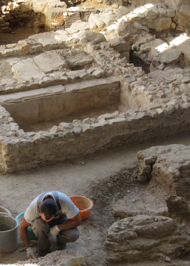
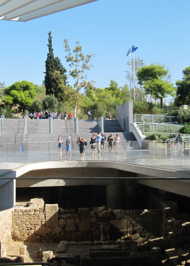
•The fourth and final competition was open only to architectural practices by invitation. The new plans were adjusted so the building would be elevated on pillars above ground so as not to disturb the archaeological site. The New York based architect Bernard Tschumi in collaboration with the Greek architect Michael Photiadis won the competition. The excavations revealed two layers of modest private houses and workshops from the Byzantine era, and another from the classical era. Once the findings were established working around the archaeological finds, the locations for the pillars of the building were established, floated on roller bearings to withstand an earthquake with a magnitude of 10 on the Richter scale.
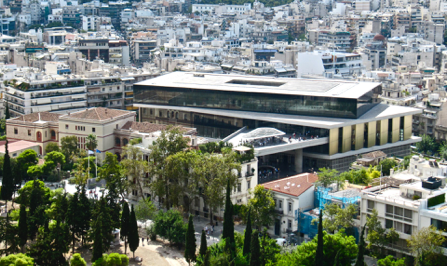
The museum contains sculptures that had to be removed from the Acropolis rock, then transported 280 meters/918 feet to the museum itself. Three tower cranes moved the sculptures during a four month period without mishap. Greek officials expressed their hope that the new museum would help in the campaign for the return of the Parthenon Marbles. The Acropolis Museum opened on June 21, 2009. Inside the Parthenon Gallery, a rectangular, solid concrete core was built to the same dimensions and orientation of the Parthenon. It was especially designed to receive and display the entire temple frieze. The visual link between the Parthenon sculptures exhibited in the Museum and the monument from which they originated is achieved through the transparent glass outer walls of the Parthenon Gallery. From this gallery, the visitor is treated to a breathtaking view of the Acropolis, the surrounding historic hills and the modern city of Athens. The museum houses its collections on three levels as well as the archaeological excavation that lies at its foundations:
*The Ground Floor: contains the Gallery of the Slopes of the Acropolis. Objects Anthenians used in everyday life from all historic periods are displayed in glass cases built into both walls in a spacious gallery. Explanations and labels written in Greek and English accompany the objects.
•First Floor Gallery: the Archaic Gallery, a 9 meter/29.5 foot high gallery with natural lighting contains sculptures that graced the first temples of the Acropolis. It also displays the votive offerings dedicated by the worshipers, such as the archaic Korai (depictions of young women) the Hippeis (horse riders), statues of the Goddess Athena, sculpture of male figures, marble reliefs, and smaller bronze and clay offerings.
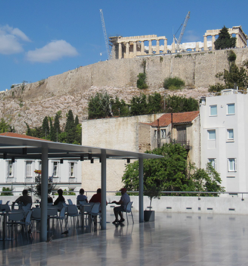
•Second Floor: Offers the visitor a respite, with refreshments served indoors or outdoors on a terrace with a view of the Acropolis and the Parthenon. A book store is also on this level.
•Third Floor: Parthenon Gallery. This glass-encased gallery exhibits the relief sculptures of the Parthenon Frieze depicting the Panathenaic processing in a continuous sequence along the perimeter of the external surface of the rectangular concrete core of the gallery. The metopes, the marble slabs with relief representations from Greek mythology, are exhibited between the stainless steel columns of the gallery, the same number as the columns of the Parthenon. The colossal figures of the two pediments have been placed on the east and west sides of the gallery. The east pediment depicts the birth of Athena , having emerged from the head of her father, Zeus; and the west pediment depicts the battle between Athena and Poseidon over the land of Attica. Athena was victorious, hence the name of the city, Athens.
•After visiting the Parthenon Gallery, the visitor can then return to the first floor to complete the tour with the series of works that were created after the construction of the Parthenon, namely: the Propylaia, the Temple of Athena Nike, and the Erechtheion. The north wing of the First Floor displays striking Classical sculptures and their Roman copies, as well as votive and decree reliefs from the 5th and 4th centuries BC. as well as select works dating from the end of antiquity and early Byzantine periods.
Henry had majored in Greek Classics at Harvard, and his knowledge enhanced our visit to the Acropolis Museum. We spent three hours looking at each object within the museum, as well as walking around the Parthenon Gallery several times. The Third floor galleries also included an educational film describing the architectural history of the Parthenon, its building, and the history of its destructions, so interesting that we viewed it twice. This new museum truly brought the Parthenon to life. Seeing this marvelous re-creation in view of the Parthenon on the Acropolis has enriched our understanding and knowledge of ancient Greece, the cult of Athena, and the Age of Pericles. Henry and I intend to pay another visit to the British Museum in order to reacquaint ourselves with the actual marble sculptures from the pediments. It would be remarkable if the Parthenon Marbles (known in England as the “Elgin Marbles”) were returned to Greece and the Acropolis Museum, especially now that Greece has provided such an extraordinary, state-of-the art venue befitting these 5th century BC originals from Hellenic Athens.
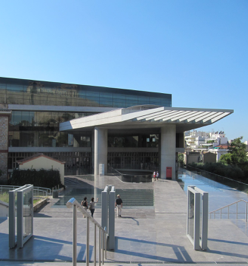
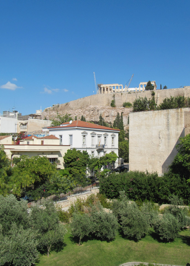
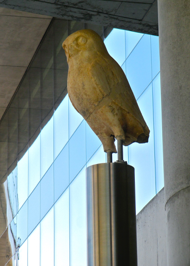
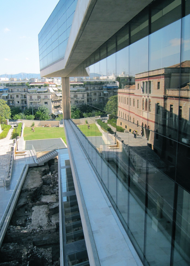
PHOTOS: Top Two 1. Entrance Level of the Acropolis Museum, Athens. 2. Ancient sculpture of an owl, symbol of the goddess Athena for whom the city of Athens is named. The owl is displayed on a stainless steel column, similar to the ones used to designate the columns of the Parthenon on the top level of the museum. Middle Three: 1. View from the museum entrance looking toward the street. Below ground, defined by the bow of the terrace, is an archaeological dig,. 2. Entrance to the Acropolis Museum, its 3. Reflections in the glass façade of the Acropolis Museum. Its sleek profile does not distract from the Acropolis itself, and the reflective glass building blends with the architecture of the city Bottom Three: 1. Archaeological dig beneath the museum’s terrace. An archaeologist was working on an ancient herringbone brick floor when we visited the museum. 2. Rooftop terrace restaurant on the 2nd level of the museum. The Parthenon stands on the Acropolis above the museum. 3. View of the Acropolis from the entrance terrace to the Acropolis Museum. Olive trees are planted in the garden adjacent to the museum.

At the Foot of the Acropolis