island of kos
Dodecanese in the the Aegean Sea
Greece, Europe
August 10-14 & September 25-27, 2011


island of kos
Dodecanese in the the Aegean Sea
Greece, Europe
August 10-14 & September 25-27, 2011

Kos, the island of Hippocrates, is the third largest island in the area within the Dodecanese complex. Located between the islands of Kaymnos and Nisyros, its area covers 295 square kilometers. The island has one mountain range, is exceedingly green, has an exceptionally mild climate, and boasts sunshine during most of the months of the year. The island attracts tourists from all points in the globe, and is a cosmopolitan tourist destination. Located on the northern end of the Dodecanese, an island chain that is in the southern part of the Aegean sea, the island has access to Kalymnos, Leros, Patmos, Nisyros, Samos, Symi, and Rhodes. The Turkish town of Bodrum is visible from the harbor of the Town of Kos, and daily excursions sail from Kos to the coast of Asia Minor. The surprising charm of Kos is its many ancient ruins, interspersed amongst more modern Greek architecture. The main town on the island is the Town of Kos, which also is the port of entry by boat. Henry and I flew to Kos from Athens, simply because the overnight ferry from Piraeus Port in Athens takes eleven hours, while a flight on Aegean Air requires only one hour. Hippocrates Airport on the island of Kos is only 5 kilometers/3 miles from the town of Kardamena with its sandy beaches and ruins of the ancient city of Alasarna. This western end of the island also has daily connections by boat to the neighboring volcanic island of Nissyros. Henry and I stayed in the town of Kos upon our arrival, a convenient place to be for ferry destinations to other islands. At the end of our nearly seven-week island hopping adventure, we returned to Kos by ferry from Nissyros, this time staying at a beautiful resort on the outskirts of Kardamena, with easy access to the airport for our return flight to Athens. The town of Kos is overrun with tourists during the height of the season in July and August. However, other popular villages listed in the guidebook on Kos include “Marmari and Tagaki with sandy beaches, plus the mountainous villages of Zia, Lagoudi, Asfendiou, and Pyli, all with magical sunset views. The mountain village of Asomatos is known for its peaceful ambience. Another peaceful choice is the village of Mastichari in the northwest, only 3 kilometers/1.8 miles from the 30-century old village of Antimachia in the center of the island. Peace and serenity dominate Mastichari, where its little harbor assures fresh seafood daily. There is also a ferry to the sponge island of Kalymnos, only minutes away. The old town of Kelfalos, on the western part of the island is 42 km/26 miles from the Town of Kos overlooking the Aegean and the nearby islet of St. Nicholas.” The area boasts the birthplace of Hippocrates, has the White Rock Cave where the first remains of human inhabitants were found, and also has ruins of the monastery of St. John the Baptist. Kos was visited by St. Paul in 57 AD, and Christianity spread quickly across the island. The island’s history is fascinating as its location has been strategic throughout the centuries. The island was originally colonized by the Carians of southwestern Asia Minor. The Dorians invaded in the 11th century BC bringing with them the cult of Asklepios from Epidaurus. During the Greco-Persian Wars, Kos expelled the Persians twice. By the 4th century, BC, democracy was instituted and the city of Kos was laid out in a grid pattern in 366 BC. Proximity to the East gave the island access to silk thread. Aristotle mentioned silk weaving with garments produced in large factories on Kos by enslaved women, according to Aristotle c. 384-322 BC. During the Hellenistic Age, Kos attained the zenith of its prosperity. Its alliance was valued by the kings of Egypt (Greek Ptolomaic Kingdom*) who used the island as an outpost for their navy to watch the Aegean. Kos became a seat of learning and the island was a provincial branch of the Library of Alexandria. Kos became the favorite place for the education of the princes of the Ptolemaic dynasty. The Venetians conquered Kos, then sold it to the Knights of the Hospitalier of Rhodes (The Knights of St. John) in 1315. With the threat of a Turkish invasion in the 16th century, the knights abandoned the island to the Ottoman Empire that then ruled Kos for 400 years, until it was transferred to Italy in 1912. The island was occupied by Italy (1929-1943) then was under Italian-German occupation under the Nazis (1943-1945) and, after WW II, became the protectorate of the British (1945-1947). It was ceded to Greece in 1947.
*The Ptolemaic Greek Kingdom began with Alexander the Great’s conquest of Egypt in 332 BC and ended with the death of Cleopatra VII and Roman conquest in 30 BC.
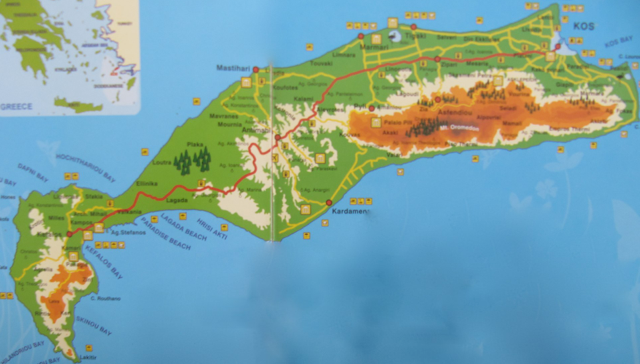
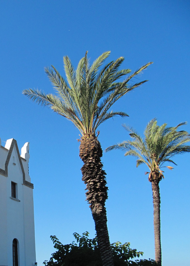
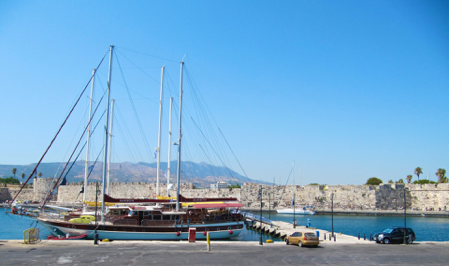
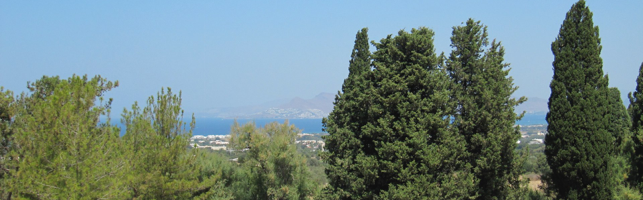
PHOTOS: Upper Two: 1. View overlooking the Aegean as seen from the Asklepeion. 2. View of the fortress Castle of Neratzia, built beginning in 1315 by the Knights of St. John/the Hospitalier of Rhodes. Center Map: Left arrow points to the island of Kos in the Dodecanese, the southeastern Aegean near the coast of Turkey (Asia Minor). The right arrow points to the Town of Kos, first laid out as a city during the Hellenic Era c. 366 BC. The orange areas indicate higher elevations. Bottom: View of Turkey (Asia Minor) from the island of Kos.

Garden of the Aegean