Budapest, hungary
EASTERN EuropE
August 26 - September 1, 2008

Budapest, hungary
EASTERN EuropE
August 26 - September 1, 2008

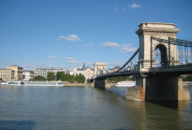
The capital city and the largest city in Hungary, Budapest has a population of 2 million people, one fifth of the population of the entire country. Not only is it the center of politics, commerce, culture and transportation, it also serves as a transportation crossroads and an airline hub in central Europe. Budapest is historically two separate cities, one on each side of the Danube, which were combined in 1873. I noticed that the locals still refer to them as Buda and Pest, distinguished by their geography and geology. The Pest side, the current city center, is where commerce and government interact. Three Parliament buildings, one now housing the Ethnographic Museum, face one another on flat ground that is characteristic of Pest. Across the river, the Buda (originally Obuda for “Old Buda” is on the mountainous side. It is in Buda, from its lofty heights, that the Royal Palace and the Fisherman’s Bastion overlook Pest,. Between the two is a small island known as Margaret Island, and several bridges which link the districts. The most beautiful of these is the Shéchenyi Chain Bridge. Gustav Eiffel’s architectural firm built another, the Margaret Bridge, on which bright yellow trams traverse its wide expanse. The third bridge in the city center is a suspension bridge the Erszébet Hid “Elizabeth Bridge, named after Queen Elizabeth, known as “Sisi”, (1837-98) Empress consort of Austria and Queen consort of Hungary, wife of the Austro-Hungarian king, Franz Josef. Budapest is a beautiful city with elegant architecture, avenues and cultural treasures. World Heritage has proclaimed the following as protected sites: the banks of the Danube River, Buda Castle Quarter, Andrassy Avenue, and the Millennium Underground Railway, which was the first subway built in Europe. The history of Budapest dates back to the Celts as Aquincum, followed by the Roman capital of Lower Pannonia. The Magyars arrived to settle the Carpathian Basin in the 9th century, followed by the Mongols in the 13th century. The 15th century brought the Renaissance humanist culture, and the Ottoman Turks laid siege in the 16th century (Margaret Island was the harem) In the 19th century, with the unification of Buda and Pest, Budapest became an international city, part of the Austro-Hungarian Habsburg Monarchy, which collapsed on October 31, 1918. Post World War I political unrest resulted in the communist Hungarian Soviet Republic in 1919. World War II‘s battle of Operation Panzerfaust in 1944, and the battle of Budapest in 1945 scarred the city. Potsdam put Hungary under the protection of Russia, which dominated them until 1989, though there was an unsuccessful political revolution to break away from communist rule in 1956. Current politics include a president, a prime minister, a cabinet and a constitutional court. Hungary became a member of the European Union in 2004. Budapest is a wonderful city to visit. It is steeped in history and culture, with beautiful architecture and wonderful food. The visitor has the feeling that Hungary’s inclusion in the European Union promotes some level of optimism, with an obvious influx of financial investment in the renovation of the city and its elegant 19th century buildings.
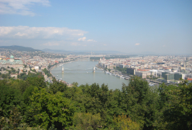
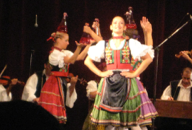
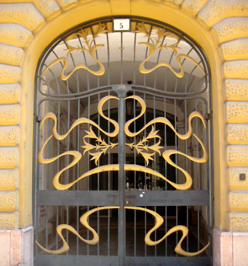
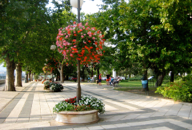
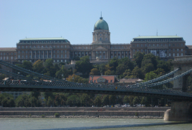
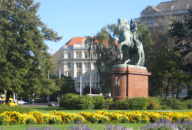
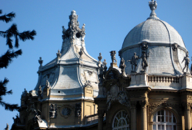
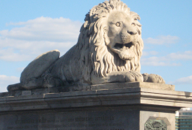
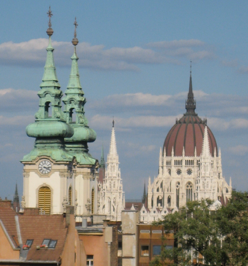
PHOTOS: Left Column: 1. One of 4 lions gracing the Shéchenyi Chain Bridge. 2. Shéchenyi Chain Bridge crossing the Danube between Buda,and Pest, background. 3. Promenade on the Danube at the Shéchenyi Chain Bridge 4. The Royal Palace, Castle District, North Buda. Center, Top: Photo taken from the Buda side of the Danube with church towers in the foreground and the Domes and spires of Parliament on the Pest side in the background. Center, Bottom: Gates on a building near St. Stephen’s Basilica. Right Column: 1. Budapest as seen from the Castle District of North Buda. 2. Dancers of the Hungarian State Folk Ensemble performing folk dances on the Duna Palace theater stage. 3. Kossuth Lajos tér, a garden in Parliament square. 4. Domes of Vajdahundyad Castle near the zoo and botanical gardens.

Center of Europe