BOROBUDUR TEMPLE
architecture
The Kedu Plain, central java, indonesia
april 13, 2009


BOROBUDUR TEMPLE
architecture
The Kedu Plain, central java, indonesia
april 13, 2009

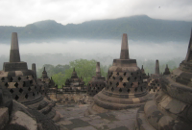
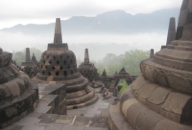
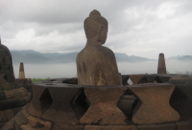
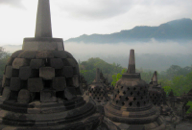
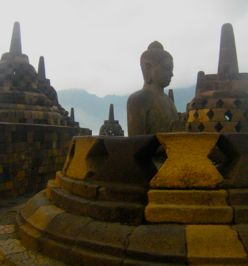
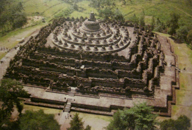
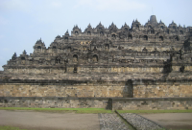
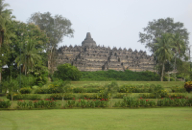
Borobudur Temple , dating from around 800 A.D., was built in the shape of a square mandala on top of a small hill, the shape symbolic of a mountain. Originally, the hill on which the temple stands was terraced, with the temple’s stepped design a continuation of the landscape itself. The mountain shape was an important religious symbol to Javanese Buddhism, as sanctuaries were often built on mountaintops. Buddha had revealed important scriptures on the top of mountains; and, the builders, the family of kings who built Borobudur, were known as the Salindras, or “Lords of the Mountain”. The Universe, in Buddhist belief, is a complex system of three realms with a great mountain at its center, called Mount Sumeru. The three realms are: The Realm of Desire, the Realm of Form, and the Realm of Formlessness. The third realm, is considered to be the realm of enlightenment, from which the wheel of life and the cycle of birth, death, and rebirth has ended for the enlightened soul. The Eight Fold Path of Buddha’s teachings direct the initiate toward his goal of reaching enlightenment through the releasing of desires and the mastery of human consciousness. Visiting the Borobudur Temple required a particular pattern of approach. Although we initially ascended the stairway to the uppermost level, Payiat lead us back to the first level to walk clockwise through the galleries of stone carvings. These carvings, some especially deep reliefs, depict various stories and teachings, including the life of Sidhartha, a prince who became the enlightened Buddha. The architecture of Borobudur Temple is also symbolic of a stupa, the summit of which is crowned with one gigantic stupa, now missing its large pillar. There is no record of the size or shape of this column; therefore, it has not been replaced. The stupa shape dates to pre-Buddhist India, whereby a burial mound of earth was topped by a wooden pillar which represents the connection of heaven, earth, and the underworld. Buddha is said to have asked to be buried under a stupa; hence, eight stupas, each representing a major event in his life, house his cremated ashes in eight different locations in India. At Borobudur, beneath the uppermost stupa, there are 72 additional stupas, arranged on three separate levels. The number 72 has significance in Buddhism. Symbolically, the sum of these two numbers equals 9, a number which represents enlightenment. The Mandala: The square shape of Borobudur Temple is also thought to represent a mandala, a pictorial diagram used ceremonially to initiate people to higher levels of spirituality. Although the word means “circle”, the mandala also uses a combination of shapes including squares and triangles in its overall form. The fact that this temple faces the four cardinal points, has statuary in niches on the balustrades, and correspond to the Buddha Diamond World mandala, gives scholars clues to the use of this temple. Because there are no writings describing ceremonies performed here, the idea of the mandala is more conjecture than fact. As Henry and I listened to Priyana, we marveled at the amazing carvings, and the various symbolic vocabulary and skilled sculptural depictions of Buddhist stories and teachings. We were also amazed to find actual sculptures representing the Buddha encased in open-work stupas, as well as various forms of Buddha in meditation.
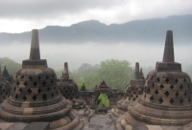
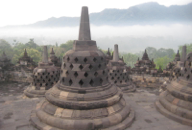
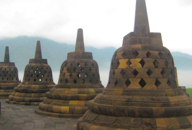
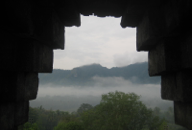
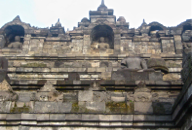
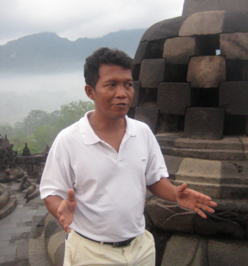
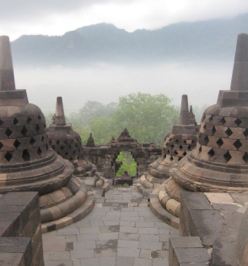
PHOTOS: Left Column: 1. Layers of stupas in the morning mountain mist. 2. The terraced stupas in two forms: diamond patterns representing the path through aspiration or search, and the square representing the goal in balance, or achievement. 3. A Buddha sculpture revealed inside one of the stupas. 4. View of the surrounding volcanic mountains as scene through a ziggurat shaped portal on the temple’s stepped formation. 5. Many Buddha sculptures in meditation, all overlooking the landscape. 6. Aerial view of Borobudur, showing the shape as a mandala and the stepped formation as a mountain. Center, Top: Our guide, Priyana, explaining the significance of the architecture of Borobudur. Center, Middle: View of a gateway, with a partial view of the 72 stupas on the monument. Center, Bottom: A Buddha figure, exposed within a stupa. Right Column: 1 & 2. View from the stepped “mountain” of Borobudur. 3. The stepped arrangement of stupas with the mountain mist beyond. 4. An arrangement of diamond-motif stupas. 5. Detail: The various levels comprising the Temple of Borobudur. 6. View of Borobudur from the formal Buddhist research center.

ARCHITECTURE OF SYMBOLISM