LEMPAD STUDIO
RUMPAH PELUKIS & PEMANHAT
the House of painter & sculptor I gusti nyoman lempad
Ubud, CENTRAL BALI, INDONESIA
MARCH 29, 2009


LEMPAD STUDIO
RUMPAH PELUKIS & PEMANHAT
the House of painter & sculptor I gusti nyoman lempad
Ubud, CENTRAL BALI, INDONESIA
MARCH 29, 2009

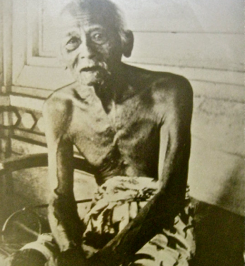
I Gusti Nyoman Lempad the famous Balinese painter, sculptor, and architect, lived between the years 1862* and 1978. Son is the son of I Gusti Ketut Mayuko, a traditional architect of the Blahbatuh Kingdom of Bali, who was repelled by the king due to his brightness. There were two reasons his father did not send I Gusti to school: (1) because he knew that his son was bright, and (2) he feared that if his son showed his intelligence, he would have a short life. In spite of his father’s fears, I Gusti was long lived, married before Krakatoa erupted with massive explosions off West Java in 1883. His fame as a painter stems from the fact that his association with Rudolf Bonnet and Walter Spies, European artists who lived and worked on Bali. The three of them plus other local artists formed a non-profit association, Pitamaha, with the goal of promoting quality work and exhibitions of their art in major cities such as Amsterdam, Tokyo, and Paris. Lempad is respected not only because of his multi-faceted talents, but because his painting and drawing style stayed true to his Balinese roots. Though he had no formal schooling, he had an alert mind and great intelligence, enough to sustain a conversation and convey his bright ideas with other artists and the anthropologist, Margaret Mead, who lived for some time in Bali. He left a legacy of architecture in the Museum Puri Lukisan, in the Puri Saren Palace; and, in his studio and family compound, open to visitors. The north and east pavilions of this compound were built by him. Many of his paintings are in the collection of the Museum Puri Lukisan.
*Note: The date of I Gusti Nyoman Lempad’s birth is in question, as Balinese during this era had no accurate record of their birth dates. It could have also been 1857, 1865, for example.
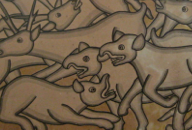
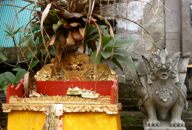
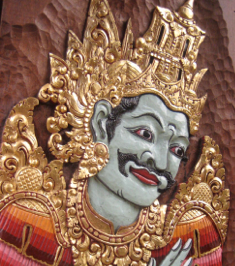
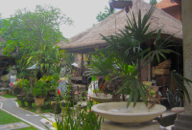
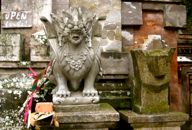
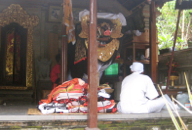
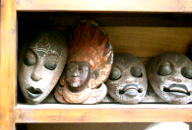
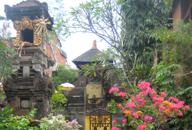
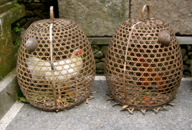
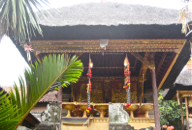
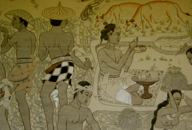
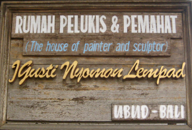
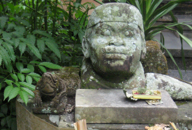
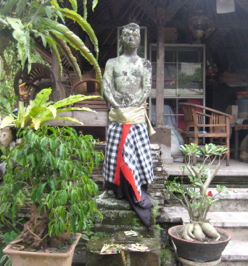
PHOTOS: Left Column: 1. Sign identifying Lempad House in Ubud. 2. View of the Lempad family compound from the entry. 3. Sculpture guardians at the front gate. 4. Detail: painting by I Gusti Nyoman Lempad in the collection of the Museum Puri Lukisan. 5. Detail: Shrine in the temple of the Lempad family compound. 6. Stone sculpture with offerings. Center, Top: Carved and painted door at the gate to Lempad House. Center, Middle: Photograph of I Gusti Nyoman Lempad. Center, Bottom: Stone sculpture with Poleng stands before one of the pavilions in the compound. Right Column: 1. Offerings and stone sculpture outside the gates of Lempad House. 2. Open pavilion with ceremonial decorations. 3. Detail: Ink drawing by I Gusti Nyoman Lempad. This is in the collection of the Museum Puri Lukisan, Ubud. 4. The temple in the Lempad family compound. 5. A collection of carved wooden masks in Lempad House. 6. Cock fighting roosters in their cages at Lempad House.

Artist, Architect