HARMONY STREET
Malacca/Melaka
State of Malacca, southern peninsula,malaysia
Late Afternoon of February 26, 2009


HARMONY STREET
Malacca/Melaka
State of Malacca, southern peninsula,malaysia
Late Afternoon of February 26, 2009

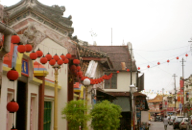
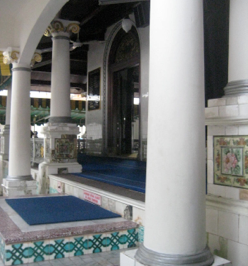
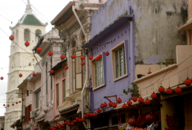
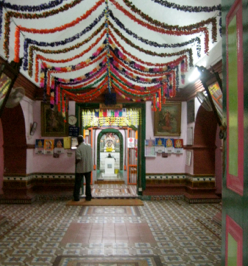
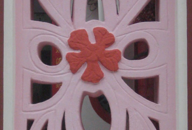
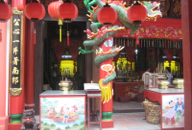
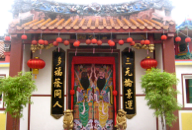
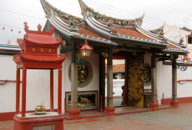
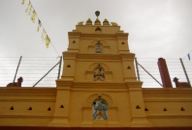
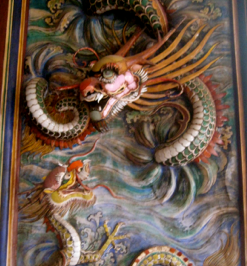
The multi-ethnic and multi-religious communities which inhabit the historic port city of Malacca seem to come together on one street, Jalan Tokong or Temple Street, also referred to as “Harmony Street”. This nickname is aptly applied to express the tolerance with which the Buddhists, Christians, Hindus, and Muslims, who worship their god and various deities here, have stood shoulder to shoulder on this ground. The street is lined with houses and shops, interspersed with ziggurats, temple gates, and personified gods in bright colors, all blessing the populace who worship here. The first stop we made behind our guide, Donovan Casimir Louis, was the Cheng Hoon Teng Temple. This is the oldest Chinese temple in Malaysia, founded in the 17th century and dedicated to Kuan Yinn, the goddess of mercy. Its restoration, completed in 2005, won an award from UNESCO World Heritage Awards. The “Cut and Paste” three-dimensional porcelain work which adorns the roof, illustrates scenes from Chinese mythology. The interior of the temple is richly adorned with paintings, symbolic carvings, lions, golden phoenix, and mythical creatures. A prayer screen depicting the life of Buddha and a watercolor of Lao Tzu, the Chinese philosopher and founder of Taoism are displayed in this temple which welcomes visitors, even as worshippers attend their devotions. With graciousness, we were also welcomed to step inside Sri Poyyatha Vinayagar Moorthi Temple, a Hindu temple along this street. A tower painted the color of saffron was decorated with colorful images of Ganesh or Vinayagar, the elephant-headed god of wisdom. This is the oldest surviving Hindu temple in Malaysia, built in 1781, on the site of Malacca’s first chitty, or Indian Peranakan settlement. At the back of the temple is an image of Vinayagar. However, the main hall, site of many weddings, could not help but bring a smile. The swags of colorful tinsel, the pink walls, and patterned tiles conveyed pure joy. Along this street also stands the Kampung Kling Mosque, founded in 1748, one of the oldest mosques in Malaysia. It’s original building of wood was replaced with the same design in brick in 1872. The architectural structure is an eclectic mix of Sumatran, Chinese, Malay, and European styles. The green tiled roof is of Hindu influence, while the pagoda-shaped minaret has been influenced by both Chinese and Moorish cultures. Lastly, we passed the newly constructed Xianglin Temple, which was colorful and photogenic. It’s red lanterns, white washed walls, and red floral motif in pink cutout stucco were all charming, adding great style and clarity to a marvelously eclectic street
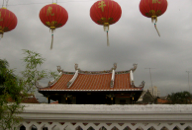
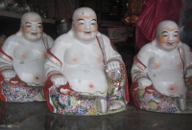
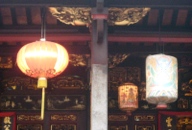
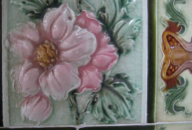
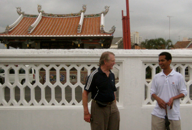
PHOTOS: Left Column: 1. A view of Jalan Tokong “Harmony” Street. Xianglin Temple is in the foreground, left. 2. Henry and Donovan, our guide, before the temple wall of Cheng Hoon Teng Temple. Two masts from a Chinese ship stand high on the temple grounds. 3. Interior detail, Cheng Hoon Teng Temple. 4. Sri Poyyatha Vinyagar Moorthi Temple 5. Detail, temple wall of Xianglin Temple. 6. Interior, Xianglin Temple. Center, Top: Detail, “Cut and Paste” porcelain work depicting a battle between two dragons, Cheng Hoon Teng Temple. Center, Middle: Kampung Kling Mosque. Center, Bottom: Sri Poyyatha Vinyagar Moorthi Temple. Right Column: 1. Lanterns floating before a leaden sky above Cheng Hoon Teng Temple. 2. Three porcelain Buddha images for sale in a shop on Jalan Tokong (Temple Street) known as “Harmony Street”. 3. A view of the pagoda-styled minaret of Kampung Kling Mosque (background, right) 4. Victorian/European styled tiles decorating the interior of Kampung Kling Mosque. 5. Xianglin Temple gate with painted figures on the wooden doors. 6. Cheng Hoon Teng Temple.
Eclectic Expressions of FAITH