hanuman dHoka palace
durbar square
kathmandu, nepal
november 6, 2009


hanuman dHoka palace
durbar square
kathmandu, nepal
november 6, 2009

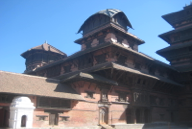
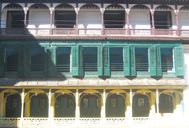
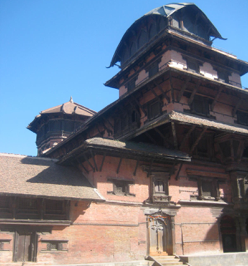
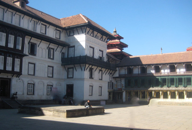
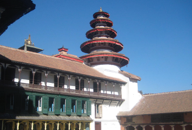
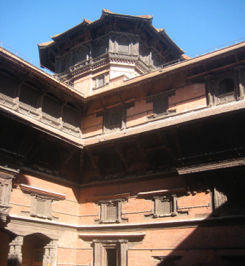
The location of the palace complex was originally founded around the 8th or 9th centuries AD, when the Licchavis, Hindus from India, settled here, prospering from the trade route between India and China. They ushered in a golden age of cultural brilliance, building stupa and monuments north of Bhaktapur and in the backstreets of Kathmandu’s old town. After a “dark ages” that lasted until the 13th century and further development through trade, most of the palace as it stands today was constructed by King Pratap Malla in the 17th century. The complex originally housed 35 chowks or courtyards, but has only 10 chowks remaining, following a devastating earthquake in 1934. The palace has been not only restored since then, but has also been renovated many times over the centuries. The entrance to the palace is through an unassuming gateway, made more important by the presence of a palace guard. Directly inside this door is a statue of Hanuman, the monkey god and brave assistant of the noble Rama. The image, dating from 1672, is housed in a protective shrine, sheltered by and umbrella and bearing the standards of the double-triangle flag of Nepal, made of brass. (See Kathmandu page for photo: Left column #3). Henry and I found ourselves in the first of two courtyards available for touring, the Nasal Chowk. In the center of this courtyard is a platform used for the coronation of the kings of Nepal. The last coronation took place as recently as 2001. To our left stood the Audience Chamber of the Malla kings, an enclosed building with three stories, each painted a different color. Behind it, but looming large above us, was the Panch Mukhi Hanuman Temple tower with five circular roofs, off limits to anyone except the temple priests. Housed in this courtyard in a small whitewashed chamber is the Dancing Shiva statue, the word “nasal” in Nepali meaning “dancing one”. The large white building on the west side of the courtyard is now the Tribhuvan Museum. The building, constructed by the Rana kings, celebrates, ironically, King Tribhuvan, who successfully revolted against the Rana regime. The exhibits were strange, such as photographs entitled “Royal Babyhood”. There were re-creations of the royal bedroom and study, memorabilia such as boxing gloves, the kings favorite bird(taxidermically mounted), hunting photos, and a coin collection. An exhibition of historic photographs and press clippings made us yawn, and we spent little time indoors. Henry and I did, however, enjoy climbing to the top of Basantapur Tower, a nine-storey tower restored for King Birendra’s coronation c. 1972. We missed, however, the story of his assassination and the massacre of the royal family, in 2001 by the disgruntled crown prince, in further exhibitions that extended beyond our interest. As we left the tower, we were directed into a second courtyard, the Lohan Chowk, where four brick towers marked the corners of the square. These were built by King Prithvi Narayan Shah, c. 1768.
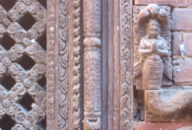
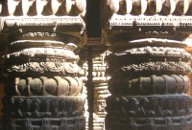
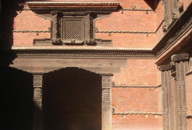
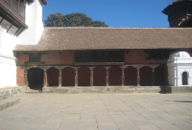
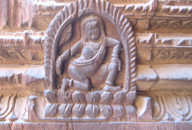
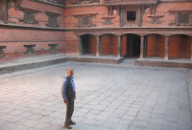
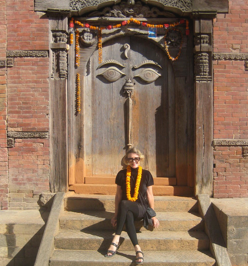
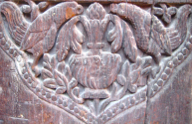
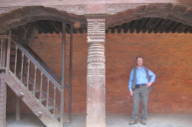
PHOTOS: Left Column: 1. View of two palace buildings, as seen across the large of two interior courtyards. The white building is the Tribhuvan Museum, c. mid-19th century. The colorful building is the Audience Chamber of the Malla kings. 2. Colorful three-storied building is the Audience Chamber of the Malla kings. 3. Carved stone details on the palace exterior. 4. Detail: intricately carved wooden columns on the façade of the palace. 5. Henry in the inner courtyard of Hanuman Dhoka Palace. 6. Detail: wood carving on a pillar made from the trunk of a single tree. Center, Top: Two palace towers that form a second quadrangle around an interior courtyard in the palace complex. Center, Middle: View of one of two towers on the palace building from the center of the second interior courtyard. Center, Bottom: Jourdan sitting on the steps before a door, carved with the eyes of Buddha, located in the palace courtyard. Right Column: 1.The Panch Mukhi Hanuman Temple tower as seen from the first interior courtyard, the Nasal Chowk.. 2. View across the Nasal Chowk toward the second interior courtyard, the Lohan Chowk, revealing three towers on brick palace buildings. 3. Covered walkway supported by carved wooden columns. 4. Details: carved wood trim on the brick façade of one of the palace buildings. 5. Henry, standing in the covered walkway of the second interior palace courtyard. 6. Carving on the base of a wooden column in the courtyard of the palace.

Palace Complex