The army Museum
The archbishop’s palace complex
Trondheim, trøndelag, norway
scandinavia
July 5, 2010


The army Museum
The archbishop’s palace complex
Trondheim, trøndelag, norway
scandinavia
July 5, 2010

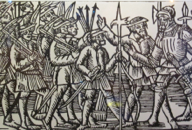
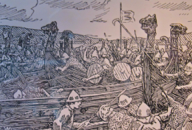
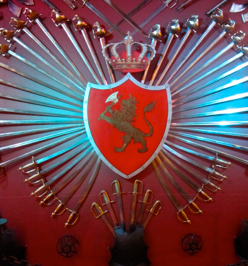
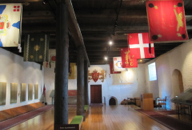
Rustkammert or Army Museum, is part of a quadrangle of stone buildings in a courtyard located next to the Archbishop’s Palace in Trondheim. This museum stands nearby the Nidaros Cathedral, where Henry and I enjoyed an afternoon exploring the history of this strategic Norwegian city. The Army Museum depicts the history of the military achievements that date back to the days of the Vikings. Uniforms, armaments, prints and paintings give an account of the military history of Norway, and is one of the chief heritage sites of the city. The museum has two floors, the lower level dedicated to the military history, and the upper level devoted to exhibitions about the period of the Nazi Occupation during World War II, referred to as the “Home Front Museum” or the “Resistance Museum”. The large hall that greets the visitors in this building of Medieval architecture has displays of heraldry, banners, and an array of royal swords. Historically accurate, both museums play an important role in recording the events that shaped the politics and society of Norway. A brief outline of Norway’s military history is as follows, proving that the country has always had the will and fortitude, when necessary, to protect itself and its interests on a larger scale:
•Viking Age: 793 - 1050 AD - Viking raids begin this period when Lindisfarne Monastery in the north sea was attacked and the people moved west. Almost one hundred years later, Harald I of Norway defeated the last of the petty kings in the Battle of Hafrsfjord forming the first united Norway, c. 872. In 991, Olaf I of Norway was victorious over the Anglo-Saxons in the Battle of Maldon. In 1030, Olaf II of Norway was defeated in the Battle of Stiklestad. This King Olav became the martyred saint that sowed the seed for the growth of Christianity in Norway.
•Early Period: 1043-1110 AD - Early victories and some defeats. Harald III defeated the English in the Battle of Fulford, taking control of York, though the Norwegians were later defeated at the Battle of Stamford Bridge. In 1107, Sigmund I led a crusade to Iberia (Spain) and the Holy Land.
•Civil War: 1130-1240: A series of wars were fought after the death of Sigmund the Crusader, with various factions attempting to put their “man” (either king or pretender) on the throne.
•Norway’s ”Golden Age”: 1240-1319 - In 1240, with the failed rising of Duke Skul Bårdsson, King Haakson and his descendants ruled the country during this Medieval period. Bergen became the first capital city of the country, with a central administration or chancellery. Laws of succession were put in place, with one single ruler of legitimate birth. Old Norse became the unifying language, used in administration, literature, and translations of foreign literature and documents. In 1260, King Haakson brought Greenland and Iceland under the rule of Norway, this expansion creating the largest territory ever in this unified country.
•War with Scotland: 1262-1266 - Norway and Scotland waged war over the control of the Hebrides and the Isle of Man. The only major battle, The Battle of Largs in 1263, was inconclusive. The Scots gained control over the Hebrides in exchange for the Norwegian rule in Orkney and the Shetland Islands.
•Union Wars 1434-1523 -These wars involved Sweden and Denmark, with Norway attempting to stay neutral. Sweden attacked Norway in 1501, but the Norwegian army pushed back. When Sweden won over Denmark, then backed out of the union, Norway was left with a much stronger partner. The elite eventually acquiesced to Danish authority, disbanding the Norwegian Riksråd. The Norwegian King remained and continued the status of Norway as a hereditary kingdom, and the Norwegian Army remained as a separate entity. However, a common fleet with Denmark was established in 1509.
•Northern Wars: 1576-1721 - This period was marked by war preparations and fighting for territory amongst these three Scandinavian countries: Denmark, Sweden, and Norway. Norway was often reluctant to go to war against its neighbors, but in 1677, Norway launched an attack on Sweden, who was already at war with Denmark, in an attempt to win back their territory lost in earlier wars. This was successful,with the Danish king surrendering these territories.
•Kalmar Wars: 1611-1613 - (one of the Northern Wars). Sweden tried to break the Danish monopoly on trade with Russia, starting a war waged amongst the three Scandinavian countries including Norway. One week later, the Swedish army was defeated at Kalmar. in 1612, a Norwegian peasant militia ambushed the Scottish mercenary army who was traveling to enlist on the side of the Swedish Army in the Kalmar War. In 1613, the Denmark, Norway and Sweden signed a peace treaty, with the Danish the uncontested power nation in Scandinavia.
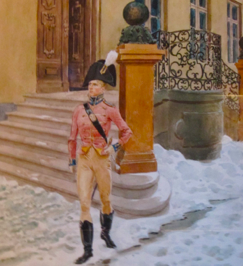
•Napoleonic Wars: 1800-1814: Norway and Denmark were allied with France, while Sweden fought on the side of the British.
•The Swedish-Norwegian War/Campaign against Norway: 1814 - Sweden waged war against Norway with 45,000 troops vs. 30,000 Norwegian troops. The Norwegian Army delivered several offensive blows on the Swedes, pressuring them to accept Norway as a sovereign nation, and opening negotiations. The result: Norway entered into a union with Sweden, but with its own constitution and parliament. This is the last war to have been fought by Sweden to date.
•German Occupation: 1940-1945- On April 9, 1940, a pro-Hitler Norwegian, attempted a coup by forming a new government. Hitler was not pleased, nor were the people of Norway. Quisling was forced to resign and Hitler appointed a new German representative plus sent the Nazi Police to expedite the German occupation of the country. See the “Home Front Museum” webpage for more details.
•War in Afghanistan: 2001-present - Norway has been one of several nations united as allies to the USA under NATO in a war against terrorism entitled “Operation Enduring Freedom”.
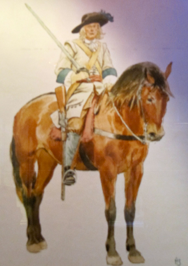
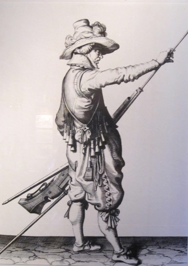
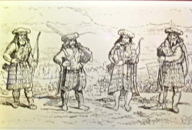
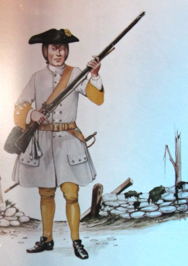
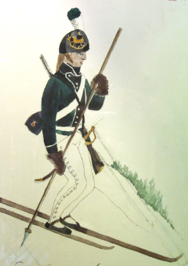
PHOTOS: Left Column: 1. During the Viking Age, King Håkon, the good, king 935-965, introduced a new conscription system called “leidang” , whereby the coast was divided into areas with each responsible for one ship with crew and weapons. Under the laws, the king was allowed, under certain conditions, to call out the leidang. For centuries, the peasants were obliged to keep arms. 2. Medieval soldiers of the Norwegian Army c. 12th century. Sigmund I led a campaign to Iberia and the Holy Land. 3. The peasants of Trøndelag were alerted and mobilized during the Kalmar Wars c. 1611-13, fought over the control of the northern territories. 4. Artistic rendering of a soldier on skis. Ski troops were introduced to the Norwegian Army in 1675. In 1808-09 during the Napoleonic Wars, more than 2000 men served in ski units. The ski troops wore a pair of skis, one long and the other short, with fur underneath to improve their grip on the snow. 5. View of the hall of the Rustkammert or Army Museum. Center, Top: The Red Lion of Norwegian royal heraldry. Center, Middle: During the Napoleonic Wars 1800-1814, Denmark/Norway were allied with the French, while Sweden was allied with the British troops. Uniform of a Norwegian officer during the Napoleonic Wars. Center, Bottom: An array of swords under the royal crown of Norway. Right Column: 1. 17th century cavalrymen, conscripted from the aristocracy. During the 1600’s each rider was equipped with helmet, breast and back armor, a sword and two pistols. The uniform and horse were provided by the soldier. 2. Norwegian soldier and his arms c. 1600. 3. Danish infantryman c. 1700, during the Northern Wars.

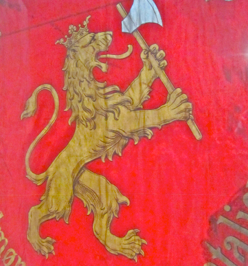
Rustkammeret