rosenborg tapestries
Rosenborg Castle
Copenhagen, denmark
Jutland peninsula, Northern Europe
july 16, 2010


rosenborg tapestries
Rosenborg Castle
Copenhagen, denmark
Jutland peninsula, Northern Europe
july 16, 2010

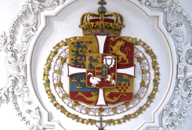
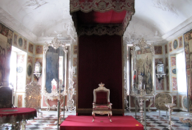
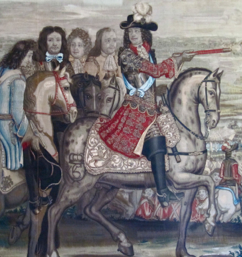
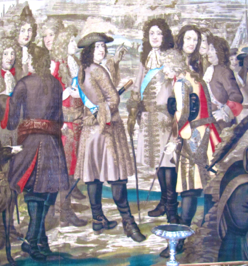
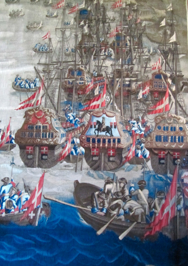
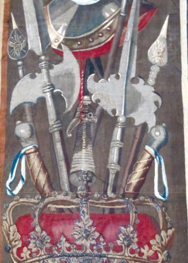
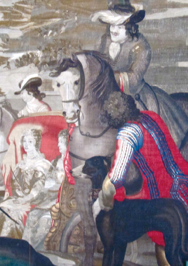
The Rosenborg Tapestries were commissioned by Christian V soon after his victories against Sweden in the Scanian War of 1675-79, a war motivated by his desire to recapture Danish territories east of the sound, including Scania, lost twenty years earlier during the reign of Christian IV. The war ended in the favor of Denmark, though because Sweden had a strong ally in France, the lands were never returned to Denmark. The tapestries, twelve in number were woven by Flemish weavers brought to Copenhagen under the master weaver Bernt van der Eichen. In the twelve tapestries, five depict naval battles and seven depict battles on land. Eleven of the twelve cartoons for the tapestries were by the painter, Anton Steenwinckel, from the well-known family of Dutch-Danish artists. Some of the backgrounds and battle scenes were based on engravings by the Dutchman Romeyn de Hooghe. Each of the scenes depicting the battles on land, also depict the capture of a castle or a fortress. The battles depict the king as conquerer in the foreground of the composition, either standing or on horseback, pictured together with his officers, with the battle scene in the background. The Capture of Damgarten depicts the king in Swedish Pomerania wearing the Order of the Elephant, surrounded by his officers. The composition for this tapestry was inspired by Louis XIV’s L’Histoire du Roi. It is also considered possible that Willem van de Velde’s many compositions of naval battles inspired the designs for these scenes. The broad decorative borders show various motifs referring to warfare, together with the royal coat of arms, the Order of the Elephant, and a cartouche with a verse in German. The borders of the naval battle scenes also depict maritime objects. Most of the tapestries bear Berent van der Eichen’s signature and the Copenhagen city symbol, three towers and the initials CH. The new tapestries, which replaced Christian IV’s morally edifying suite of images, were woven in Copenhagen between 1684 and 1693, then hung in Rosenborg’s Long Hall in 1698. In an attempt to create symmetry in the room, some of the tapestries were hung over the windows. In 1917 the tapestries were restored, then hung in the Great Hall of the newly built third Christiansborg Palace, the dimensions of which were made to fit the Rosenborg Tapestries. In 1999, the tapestries were returned to their intended home, installed once again at Rosenborg Castle to make way for Christiansborg’s own recently-completed tapestry series. The Danish Rosenborg tapestries, woven by Flemish weavers, have a place in Danish art history. However, there is another set of Swedish tapestries, woven by the French, decorating the Royal Palace in Stockholm that is considered to be of superior quality. Therefore, among art and textile experts, Sweden is considered to be the ultimate winner of the “Tapestry Wars” !
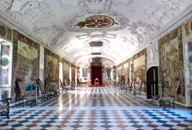
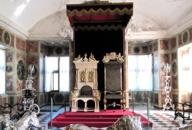
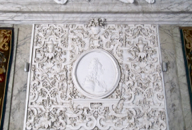
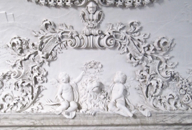
PHOTOS: Left Column: 1. Deeply carved ceiling of the Long Room with a detail of the Royal coat of arms in color. 2. Detail: carving on the barrel vaulted ceiling of the Long Room. 3. Profile portrait caved in stucco above a fireplace in the Long Room. Two of the twelve tapestries frame this piece. 4. View of the Long Room. 5. View of the ceremonial throne and canopy at one end of the Long Room. 6. View of a pair of ceremonial thrones and canopy on the opposite end of the Long Room. Center, Top: Detail: Naval battle scene from the Rosenborg Tapestries, c. 1685-93. Center, Middle: Detail of King Christian V of Denmark in one of the battle scenes depicted on land. This scene was inspired by Louis XIV’s L’Histoire du Roi tapestries. Center, Bottom: Detail: Rosenborg Tapestry composition depicting Christian V in the center right, surrounded by his officers. Right Column: 1. Detail: One of the five colorful naval battle scenes in the Rosenborg Tapestries. 2. Detail: Border design with a group of lances and halberts surrounding a depiction of one of the seven land battle scenes in the Rosenborg Tapestries. 3. Detail: Land battle scene of one of the twelve Rosenborg Tapestries, c. 1685-93.

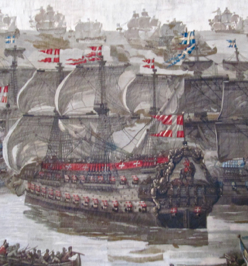
Christian V’s Victories in the Scanian War
1675-1679