copernicus


copernicus

Nicolaus Copernicus, was known as Nikolaus Kopernikus in German, or Nicolò Copernico in Italian ... and, in Polish, Mikolai Kopernik or, in his youth, Niclas Kopernigk. He was born as the youngest of four children on February 19, 1473 in the city of Torún in Royal Prussia, part of the Kingdom of Poland. He was named after his father, who was a merchant from Kraków. His mother was the daughter of a wealthy Torun merchant. Though he never married or had children, he looked after his sister Katharina’s five children until his death Copernicus was a mathematician, astronomer, jurist with a doctorate in law, a physician, a quadri-lingual polygot, a classics scholar, translator, artist, Catholic cleric, governor, diplomat, and economist. He matriculated at the University of Kraków, later known as Jagiellonian University beginning in fall of 1491 semester until the summer of 1495. He began his studies in the Department of Arts during the heyday of the Kraków atronomical-mathematical school, where he acquired the foundations for his later mathematical achievements. His studies gave him a grounding in the mathematical-astronomical knowledge taught in the university including arithmetic, geometry, geometric optics, cosmography, theoretical and computational astronomy. He also gained knowledge of the philosophical and natural science writings of Aristotle and Averroes, which would play a role in shaping his theory, stimulating his interest in learning and making him conversant with humanistic culture. His four years spent at the university played an important role in the development of his critical faculties and initiated his analysis of the logical contradictions in the two most popular systems of astronomy: Aristotle’s theory of homocentric spheres, and Ptolemy’s mechanism of eccentrics and epicycles--the surmounting and later discarding of which constituted the first step in the creation of Copernicus’ own doctrine of the structure of the universe. Without taking a degree, Copernicus left Kraków for the court of his uncle Watzenrode, who in 1489 had been elevated to Prince-Bishop of Warmia. Soon after, his uncle sent him and his brother, Andrew, to study law in Italy with a view of furthering their ecclesiastic careers and strengthening his own influence with the Warmia canonry. Copernicus and his brother Andrew spent the jubilee year 1500 in Rome to perform an apprenticeship at the Papal Curia. He continued his astronomical work begun in Bologna, observing a lunar eclipse on November 5-6. He studied medicine at the University of Padua between 1501 and 1503, and during this time passed his examinations to receive his doctorate in canon law. During his time in Padua, there is evidence that he crystallized the idea of basing a new system of the world on the movement of the Earth. At the age of 30, he returned to Warmia where he became his uncle’s secretary and physician between 1503 and 1510. He resided in the Bishop’s castle and began work on his heliocentric theory. Between 1510 and 1512, Copernicus moved to Frombork, a town northwest of the Vistula Lagoon on the Baltic Sea coast. In April, 1512, Copernicus participated in the election of Fabian of Lossainen as Prince-Bishop of Warmia, replacing his uncle who had died. A few months later,the chapter gave Copernicus an “external curia”, a house outside the defensive walls of the cathedral mount. In 1514, he purchased the northwestern tower within the walls of the Frombork stronghold. . Between 1512 and 1516, he conducted astronomical observations from his external curia using his astronomical instruments. Some time before 1514, he wrote an initial outline of his heliocentric theory After a raid, carried out by the Teutonic Order in 1520 that destroyed the chapter’s building and his astronomical instruments, Copernicus used primitive instruments modeled on ancient ones (the quadrant, trirquetrum, and amillary sphere) for his astronomical observations from a tower, conducted between 1522-1543. At Frombork, Copernicus conducted over half of his more than 60 registered astronomical observations. Nicolaus Copernicus wrote the epochal book, Ed revoluionibus orbium coelestium, or On the Revolutions of the Celestial Spheres, published before his death in 1543. Legend has it that on the day of his death, May 24, 1543, suffering from apoplexy and paralysis, Copernicus was presented with an advance copy of his book. When the book was placed in his hands, allowing him to take farewell of his life’s work, he is reputed to have awoken from a stroke-induced coma, looked at his book, then died peacefully. His book is often regarded as the starting point of modern astronomy and the defining epiphany that began the scientific revolution. His heliocentric model, with the Sun at the center of the universe, demonstrated that the observed motions of celestial objects can be explained without putting Earth at rest in the center of the universe. His work stimulated further scientific investigations and became a landmark in the history of science that is referred to as the Copernican Revolutions.
NOTE: Copernicus “Commentariolus” summarized his heliocentric theory. It listed the “assumptions” upon which the theory was based as follow:
1. There is no one center of all the celestial circles or spheres.
2. The center of the earth is not the center of the universe, but only of gravity and of the lunar sphere.
3. All the spheres revolve about the sun as their mid-point, and therefore the sun is the center of the universe.
4. The ratio of the earth's distance from the sun to the height of the firmament (outermost celestial sphere containing the stars) is so much smaller than the ratio of the earth's radius to its distance from the sun that the distance from the earth to the sun is imperceptible in comparison with the height of the firmament.
5. Whatever motion appears in the firmament arises not from any motion of the firmament, but from the earth's motion. The earth together with its circumjacent elements performs a complete rotation on its fixed poles in a daily motion, while the firmament and highest heaven abide unchanged.
6. What appear to us as motions of the sun arise not from its motion but from the motion of the earth and our sphere, with which we revolve about the sun like any other planet. The earth has, then, more than one motion.
7. The apparent retrograde and direct motion of the planets arises not from their motion but from the earth's. The motion of the earth alone, therefore, suffices to explain so many apparent inequalities in the heavens.
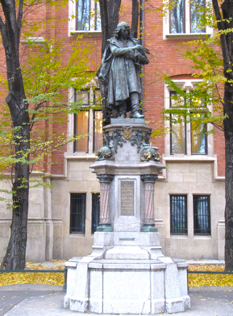
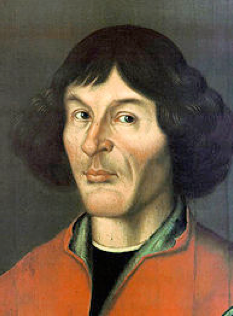
PHOTOS: Left: A bronze sculpture, a monument to Nicolaus Copernicus, student of the Kraków Alma Mater. The work was designed by Cyprian Godebski where it originally stood in the courtyard of the Collegium Maius. In 1900, it was transferred to the Planty Park where it stands before the Collegium Physicum, in front of another Neo-Gothic edifice. Right: Portrait of Nicolaus Copernicus c. 1580 in the Old Town City Hall of his birthplace, Torun, Poland.

Mikolai Kopernik ... Niclas Kopernigk