armadale castle & gardens
clan donald skye visitor’s center
sleat, isle of skye, new hebrides
Scotland, United Kingdom
british isles
august 31, 2010


armadale castle & gardens
clan donald skye visitor’s center
sleat, isle of skye, new hebrides
Scotland, United Kingdom
british isles
august 31, 2010

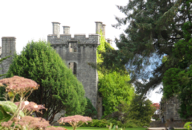
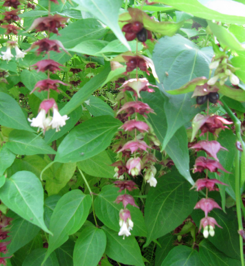
The Museum of the Isles that stands on the grounds of the Donald Skye Visitor’s Center, which includes the Stables Restaurant, and Armadale Castle and Gardens, tells the history of the earliest people in the Orkney Islands and the Shelter Islands. It also puts into context the Clan Donald, which was at the heart of the early history of Gaeldom. The Kingdom of the Lordship of the Isles encompassed the western mainland and the Hebrides, with the Clan Donald at its head. Tradition marks the beginning of the Lordship to the 12th century, which was the time of Somerled, the greatest of Gaelic heroes, and the progenitor of Clan Donald. According to the museum’s history “In their time, there was great peace and wealth in the isles through the administration of justice”. At the museum, we learned that the prefix “mac” means “son of”, which certainly enlightened me about the variations in clan names, such as Donald and MacDonald. The more recent evidence of Clan Donald lies in the castle ruins, its beginning in 1790, when the mansion was a large house of rectilinear shape. A gothic castle extension was added in 1815, designed by James Gillespie Graham and financed by income from the kelp industry. A fire destroyed most of the building in 1855, and in 1858 the center section was replaced by a building designed by David Bryce. In 1975 the building was restored to house the Museum of the Isles, which now stands elsewhere on the property in a new building. Henry and I enjoyed learning more about Skye and the Kingdom of the Isles; and, thoroughly enjoyed walking through the extensive gardens around the castle ruins. Wide paths lead through a Wildflower Meadow, the Sleat Path, and into the formal gardens. Narrow walking paths cut through dense woods planted on the rolling hills. The plantations of centuries-old trees, many which were unusual varieties such as the Monkey Puzzle Tree or the Lantern Tree, both from Chile, revealed a clan that traveled widely and brought botanical specimens to add to their gardens. The stone banked border garden, overflowing with unusual flowers, brought color to the mossy gray stones. Our curiosity about the species of various plants was often satisfied by identifying signs, although the spectacular colors and shapes of leaf, flower, limb and and bark was enough to keep us engaged for hours.
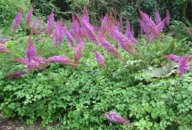
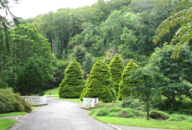
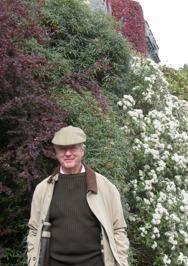
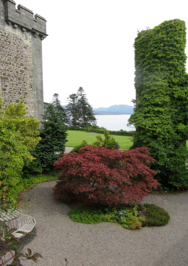
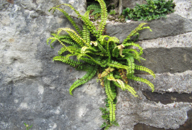
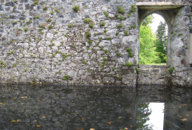
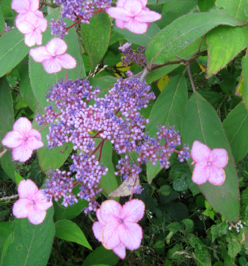
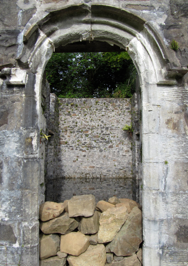
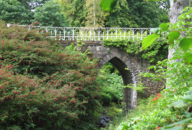
PHOTOS: Left Column: 1. A gothic archway of a bridge crossing a small stream that meanders across the property The banks of the stream were covered in flowering plants with thick green fern and stalky plants with red flowers. 2. View of the gothic portion of the castle ruin from the gardens behind it. 3. View from the entrance of the Armadale Castle Gardens. 4. Large purple plumes of Astilbe, a plant that does well in Scotland since it’s roots require constant moisture. 5. A memorial to Angus William Ranald MacDonald, a painter who lived 1918-2005. An old stone building has been flooded with water, its gothic doorways dammed with stones. Clumps of green fern are rooted in cracks between the stones, a reminder of life and beauty. 6. Detail, the fern growing on the outside of a stone window at the memorial. Center, Top: The ivy covered ruin of the Gothic portion of Armandale Castle c. 1815. Center, Middle: The amazing flowers of an unidentified flowering shrub. Center, Bottom: Lavender and purple hydrangea. Right Column: 1. Henry, standing next to the wall of a wide variety of shrubbery at the front of the castle ruin. 2. View of the Sound of Sleat from the grounds of Armadale Castle. 3. Doorway of the memorial to Angus William Ranald MacDonald.

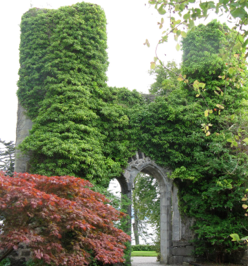
A Castle Ruin