castle varrich
sutherland
The north highlands
Scotland, United Kingdom
british isles
September 24, 2010


castle varrich
sutherland
The north highlands
Scotland, United Kingdom
british isles
September 24, 2010

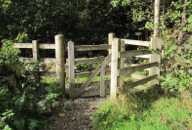
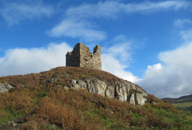
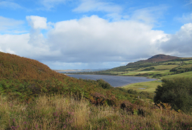
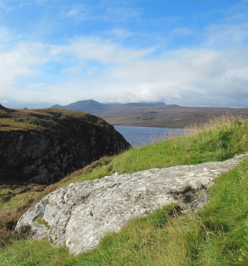
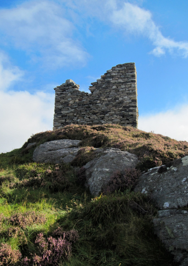
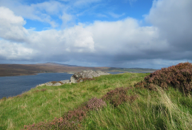
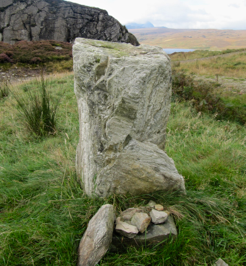
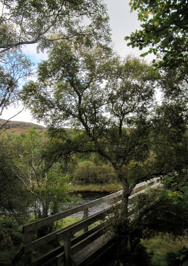
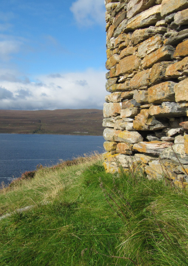
On our final morning in Tongue, Henry and walked to Castle Varrich to experience first hand the view we saw from our Tongue Hotel window. Nothing definitive is known about this ruin, as its origins are still a mystery. Some of the hypotheses surrounding the ruin include: a) that it could have been Thornfinn’s stronghold called ‘Beruvik’, where a sea battle was fought in the 11th century; b) the possibility that it could have been a Medieval resident of bishops; or, c) the probability that it was used as an early stronghold of the clan Mackay (pronounced ma-kii); or lastly, d) that a building was built on the foundations dating from prehistoric times. It doesn’t really matter what its origin or use, as this ruin creates a focal point in the landscape, and is also a wonderful spot from which to view the surrounding countryside. Our walk to Castle Varrich began on a narrow footpath in the village of Tongue, near our hotel. It continued to a gated turnstile and across a wooden bridge. The climb to the castle itself became steeper the higher the ascent to the crest of the hill. Once there, we walked around the structure itself, admiring the stonework and the lintel above the doorway. The walls were approximately 1.4 meters thick and had been built of sandstone, which had geologically been subjected to heat and/or pressure to harden it, millions of years ago. Oddly enough, judging by the damp weather of these northern highlands, the stones of the building have weathered well as a dry wall construction. The compact structure on the hilltop once had two floors plus an attic, the lower one probably used to house animals, and the upper for human habitation. No stairway unites the two, so a ladder was probably used to climb through a window into the upper chamber. According to the text posted near Castle Varrich, insight to the history of this ruin could be based on the translation of its name. Caisteal a´Barriach is thought to also be the Castle of the Lochaber Man. The cave beneath the castle is known as “Leabaidh Eòin Abraich, or ‘Iain of Lochaber’s bed. The word Abraich could have morphed into the word a´Bharraich since the “BH” would have been pronounced as a “V”, therefore evolving eventually into the name Castle Varrich. Additionally, scholars’ assessments have also considered the ruin within the context of the history of the Mackay clan. Iain Abraich, son of a Mackay chief, but reared in Lochaber, was the hero of Mackay Country. He carried a banner upon which the words Biodh Truen, Biodh Truen “Be Valiant, Be Valiant” were embroidered in gold. Local folklore recounts that Iain Abrach hid in the cave several times when he was in danger. Near the castle stood an upright stone, wind and weather worn, with small stones gathered at its foot. On this hour-long walk, from Tongue to the castle ruin and back, Henry and I were happy, not only for the exercise, but for the fulfilled desire to further appreciate the northern Scottish landscape, and to learn a bit more about the history and culture of the northern-most lands of the United Kingdom.
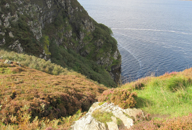
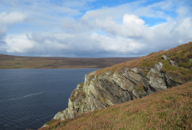
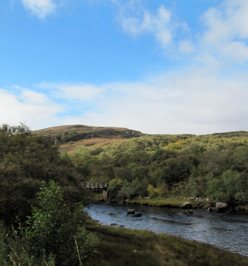
PHOTOS: Left Column: 1. View of Castle Varrich from the perspective of the climb. 2. The gated stile leading to the upper footpath toward Castle Varrich. 3. A tributary of the Kyle of Tongue with its wooden footbridge crossing. 4. View of the Kyle of Tongue from beneath the crest of the hill. 5. View looking down to the Kyle of Tongue from beneath the hill where Castle Varrich stands. Center, Top: View of a tributary of the Kyle of Tongue Center, Middle: Boulders and views beneath Castle Varrich. Center, Bottom: The weather-worn standing stone beneath the crest of the hill where Castle Varrich stands. In the background is the silhouette of Ben Loyal at 763 meters/ 2,506 feet. Right Column: 1. Castle Varrich as seen from beneath the crest of the hill. 2. View of the Kyle of Tongue. 3. Standing on top of the hill next to Castle Varrich. 4. View of the Kyle of Tongue from Castle Varrich.

Views from the Castle Ruin