charles rennie mackintosh
&
Margaret Macdonald
glasgow, Scotland,
United Kingdom
British Isles


charles rennie mackintosh
&
Margaret Macdonald
glasgow, Scotland,
United Kingdom
British Isles

Charles Rennie Mackintosh was born on June 7, 1868 in Glasgow on the River Clyde. The city would have a profound effect on his life, and later he would have a profound effect on the city’s architecture. The city and time period in which he was born was teaming with the heavy engineering industry and shipbuilding during the Industrial Revolution. By 1870 Glasgow was considered the “Second City” of the British Empire and produced more than half the tonnage in British shipping, and more than a quarter of all the locomotives in the world. The importation of goods from Asia, the link between Japan and the shipbuilding industry in Scotland; and, because of the close link between these two countries, his exposure to Japanese design, would also have its effect on his aesthetic. These were circumstances that would inform his art and architecture. In 1884 he began an apprenticeship in architecture with John Hutchinson at the age of 16, and later worked in a local practice as the assistant of John Keppie in Glasgow. He also studied art and design in evening classes at the Glasgow School of Art. In these classes he he met his future wife, Margaret MacDonald. her sister Francis, and Herbert MacNair. “The Four”, as they were called, became prominent in the “Glasgow School” where they collaborated on designs for furniture, metalwork and illustration, developing a highly distinctive style using lines and stylized images influenced by the new movement of Continental Art Nouveau. Mackintosh’s architectural career was a relatively short one, but of significant quality and impact. All his major commissions were between 1896 and 1910, where he designed private homes, commercial buildings, interior renovations, and a church. The majority of Mackintosh's three-dimensional work was created with the help of a small number of patrons within a short period of intense activity. With the support of Francis Newbery, headmaster of the Glasgow School of Art, Macintosh won the bid to design a new art school building, his most prestigious undertaking. He also designed Queen’s Cross Church in Maryhill, Glasgow, the only church designed by Mackintosh, considered to be one of his most mysterious projects. For Miss Kate Cranston, his most loyal patron, he designed a series of interiors for her Glasgow tea rooms. His two domestic designs included Windhill, Kilmacolm for the Davidson family in 1899, and The Hill House, Helensburgh for the publisher, Walter Blackie. Between these two domestic projects, Mackintosh and MacDonald submitted their drawings for a design competition in Germany, ideas for A House for an Art Lover. Simply putting his ideas on paper turned out to be pivotal in Mackintosh’s work. In these three domestic concepts, Mackintosh further developed his personal aesthetic, stepping outside the traditional architectural styles steeped in the heavy ornamentation and romantic traditions of Scotland and Europe. His work gravitated toward the simplicity of form and use of natural materials, and the restraint and economy of means he admired in Japanese design. Instead of the use of pattern and ornament, he began to prefer the more subtle use of texture, light and shadow. He also preferred the the calming effect and the organic feeling of the interior as imbued in Japanese spaces. Mackintosh became known as a pioneer in the modernist movement and his style, developed from his Scottish upbringing, blended the flourish of Art Nouveau with the simplicity of Japanese forms, often contrasting strong right angles with foral inspired decorative touches, as in the rose, with curves and subtle touches of traditional Scottish architecture. His designs were removed from the utilitarian “form as function” philosophy of subsequent modernists like Le Corbusier. Mackintosh’s philosophy would have been more attuned to his contemporary, the American architect, Frank Lloyd Wright, in the intent to build works of art as architecture, rather than machines for living, as was the Modernist ideal that developed somewhat later during the Bauhaus era of the 1920’s and 30’s. Like Frank Lloyd Wright, Mackintosh’s designs also included specifications for detailing, decoration, and furnishings of his buildings, the majority of which were designed and detailed by his wife, Margaret MacDonald. In Europe, the originality of Mackintosh's style was quickly appreciated, and in Germany and Austria he received the acclaim that he was never truly to gain at home. In 1900 the Mackintoshes were feted in Vienna as a result of their contribution to the 8th Vienna Secession and this led to friendships with designers such as Josef Hoffmann and the commission to design the Warndorfer Music Salon. In 1902 the Mackintosh Room at the Turin International Exhibition was also enthusiastically received and he went on to exhibit in Moscow and Berlin. Despite this success and with his undoubted influence abroad, Mackintosh's work met with considerable indifference at home and his career in Glasgow declined. Few private clients were sufficiently sympathetic to want his 'total design' of house and interior and he was incapable of compromise. By 1914 Mackintosh had despaired of ever receiving true recognition in Glasgow and both he and Margaret moved, temporarily, to Walberswick on the Suffolk Coastline, where he painted many fine flower studies in watercolor. In 1915 they settled in London and for the next few years Mackintosh attempted to resume practice as an architect and designer. The designs he produced at this time for textiles, for the 'Dug-out' Tea Room in Glasgow and the dramatic interiors for Bassett-Lowke's house in Northampton, England show him working in a bold new style of decoration, using primary colors and geometric motifs. It was an output of extraordinary vitality and originality that went virtually unheeded. In 1923 the Mackintoshes left London for the South of France where Mackintosh gave up all thoughts of architecture and design and devoted himself entirely to painting landscapes. He died in London, of cancer, on 10 December 1928.
EPILOGUE:
•Though Charles Rennie Mackintosh received little recognition in Glasgow during his lifetime, by the end of the 20th century he had become recognized as the father of the “Glasgow Style”, one of the driving forces behind a new approach to modern architecture. •The University of Glasgow rebuilt the interiors of a terraced house designed by Mackintosh, and furnished it with watercolors of by Mackintosh and MacDonald, now part of the Hunterian Museum. The university owns the majority of his work in watercolors.
•In 1996-97, The Metropolitan Museum of Art in New York City held a major retrospective exhibition of Charles Rennie Mackintosh's works . In conjunction with that exhibit, there were lectures and a symposium by major scholars and screening of documentary films about Mackintosh.
•Furthermore, Glasgow has honored him with building his conceptual design competition: House for an Art Lover, which attracts approximately 100,000 visitors a year.
•The Glasgow Art School of architecture has been named for him, as well as the building he designed.
•The revival of public interest in Mackintosh has led to the refurbishing and opening of further buildings to the public, such as the Willow Tea Rooms, Glasgow and Derngate, Northampton. Willow Tea Room has been rebuilt, and examples of two of his rooms have been rebuilt in an adjacent building.
•And, the biggest compliment of all, in 2009, Clydesdale Bank issued a new series of notes celebrating the “Homecoming” and featuring famous Scots and World Heritage Sites. The image of Charles Rennie Mackintosh appeared on the new issue of £100 notes.
•The headquarters of the Charles Rennie Mackintosh Society is located in Queen’s Cross Church in Maryhill, Glasgow. The purpose of the society is to encourage a greater awareness of the work of Mackintosh as an important architect, artist, and designer.
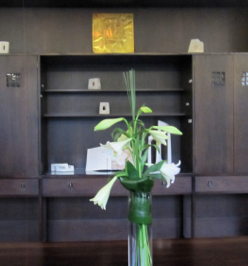
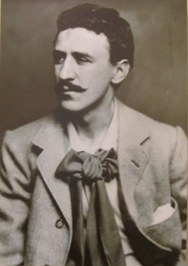
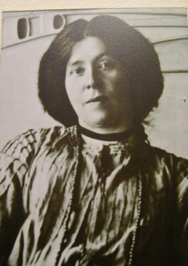
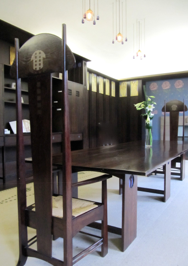
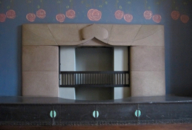
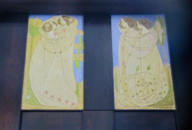
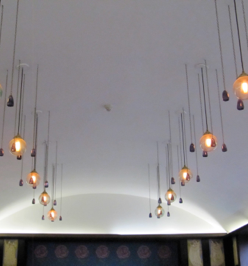
PHOTOS: Left Column: 1. Paintings on plaster, designed by Margaret MacDonald, c. 1901. 2. View of the Dining Room, House for an Art Lover, Bellahouston Park, Glasgow. 3. View of the fireplace in the Dining Room, House for an Art Lover, Bellahouston Park, Glasgow. Center, Top: Ceiling, Dining Room, House for an Art Lover, designed 1901 / completed 1996. The light fixtures are a design of Mackintosh and MacDonald. Center, Bottom: Partial view of a large sideboard and cabinet parallel to the dining table in the Dining Room of House for an Art lover. Right Column: 1. Charles Rennie Mackintosh. 2. Margaret MacDonald, his wife and collaborator in the art group named “The Four”.

Glasgow Style
1896-1910