Hallwylska Palatset
4 hamnagatan facing berzelji park
stockholm, sweden
scandinavia
july 7, 2011


Hallwylska Palatset
4 hamnagatan facing berzelji park
stockholm, sweden
scandinavia
july 7, 2011

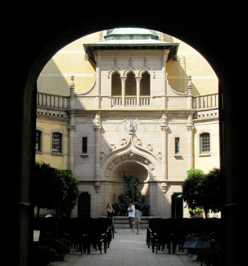
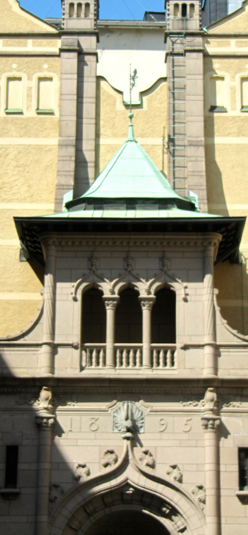
Hallwyl Palace was built between 1893 and 1898 to the design specifications of architect Isak Gustaf Clason (1856-1930) for Count Walther von Hallwyl and his wife, Wilhelmina, who married in 1865. The count was descended from ancient Swiss lineage, and the countess was heir to a vast fortune amassed by her father, Wilhelm Kempe (1839-1921), one of Sweden’s most successful “lumber-barons” in the 19th century. It was a palace created for two people, as the couple’s three daughters were already married. The purpose of the palace was to accommodate the office of the count, and to showcase the countess’s extensive collection of antique furniture, Old Master paintings, porcelain, silver, etc. The palace ranks as one of the capital’s most ambitious town houses of its period. The exterior of the building and the court is a prime example of Late-19th century Eclectic architecture, borrowing architectonic elements from medieval prototypes and Renaissance Venice. However, the architecture also made total use of the latest technology available at the time, including electricity, central heating, telephones, and plumbing. No expense was spared for this elegant building project that cost 1.5 million crowns or £85,000/US$144,500 in 1898 terms*. An elevator was later added to the palace. The countess collected her artworks during her worldwide journeys with the intention of founding a museum. Consequently, the palace was donated to the Swedish State in 1920, a decade before her death. The Hallwyn Collection was exceptionally well-documented, as the countess herself had every item, including mundane household items, catalogued in 78 volumes, printed in a limited edition of 110. The collection encompasses some 50,000 objects, and the museum opened to the public in 1938. It still houses Wilhelmina von Hallwyn’s important collections as well as personal possessions and household objects, and offers an unequalled insight into the life of an Aristocratic family at the turn of the 19th century. While Henry and I were visiting the museum, a rehearsal for an opera performance was taking place in the court of the palace. Further examples of the palace as a venue for culture within the city of Stockholm, there were also two temporary exhibitions installed in the galleries within the palace: Ardmore Ceramics, a collection example of ceramics from South Africa; and, Murano Glass, an exhibition of glass objects from Murano Italy, including a video illustrating the process and age-old techniques of glass blowing. The Hallwyn Palace is now a living museum, a monument to a bygone era, and a memorial to a remarkable woman, Wilhelmina von Hallwyn.
*Note: The cost of building the Hallwylska Palataset at 1.5 million crowns, shows that no expense was spared. The price of building the Church of St. John, a large cathedral in Stockholm, cost a mere 800,000 crowns in 1890 by comparison.
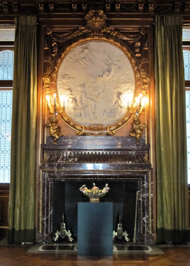
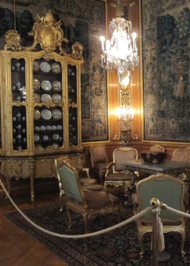
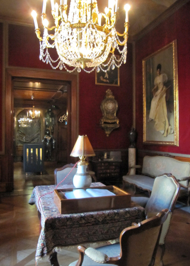
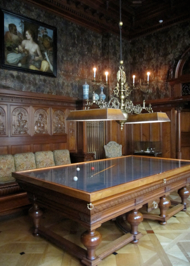
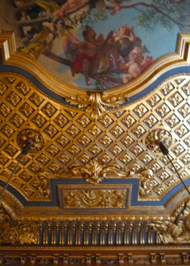
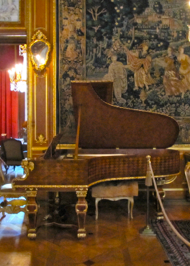
PHOTOS: Left Column: 1.The piano in the Great Drawing Room of Hallwyl Palace. The Steinway model C grand piano was delivered in 1896 with a plain pear wood case. The Countess asked the architect, I.G. Clason, to design a new parquetry case in the “Baroque” style to match the room. The instrument, considered to be one of the treasures of the collection, was restored in 1991 and is kept at perfect concert pitch. 2. Detail: ceiling painting of an open air concert is by the artist, Julius Kronberg, is the central panel in a carved gilt-clad baroque styled ceiling. 3. The Billiard Room, in Renaissance/Baroque style, was designed with walnut paneling and a deeply coffered ceiling with pendants. The billiard table was designed by the architect. Center, Top: Detail, exterior architecture in the Late-19th century Eclectic style. Center, Bottom: Detail: Court of Hallwyn Palace as viewed from the entrance port cochère. Right Column: 1. The Morning Room would have been in daily use as this was the room where the Countess received callers and did her correspondence. The room has portraits of the family. The chandelier, in the Empire Style, was made in France in the 1820’s, once owned by the Swedish Queen Désirée (1777-1860). 2. The fireplace mantel of Belgium marble in the Great Drawing Room. Each mantel in the palace was unique, designed by the architect. The fireplaces were never used as the house had central heating with concealed vents. 3. Detail: a corner of The Great Drawing Room. This room was not used on a daily basis but was reserved for festive occasions such as dinner parties, musical evenings, and balls. The room, in Late-Baroque style, was designed to accommodate the 16th century tapestries depicting Ulysses and Nausica, collected by the Countess, who was able to acquire the complete set of six works in 1894. Four are in this room and two are displayed in the Small Drawing Room, an elm-paneled room in Late-Rococo style where the ladies would retire after dinner.

Hallwyl Palace