winterthur
Canton of zürich, switzerland
Europe
January 28, 2011


winterthur
Canton of zürich, switzerland
Europe
January 28, 2011

Winterthur, in northern Switzerland, is in close proximity to Konstanz, the southern-most city in Germany on the shores of the Bodensee or Lake Constance. The city of approximately 100,000 residents is the sixth largest city in Switzerland, only 20 minutes by rail to Zürich, and near the border of Italy as well. The city has an interesting history dating back centuries to 70 AD as a Roman settlement known as Vitudurum and later Oberwinterthur, a settlement that would stand until 400 AD. The first buildings that became the old city of Winterthur were built between 600-700. The town became the capital of the counts of Kyburg in 1000, with a moat and city walls built as fortifications. When the last male of the counts of Kyburg died, the Habsburgs inherited the town, gaining city rights. Between 1415 and 1442, Winterthur begame a reichsfrei, or free city, subject only to the Holy Roman Emperor. With the Zürich War this freedom was revoked, the city coming under the control of the Austrian Habsburg dynasty. In 1467, the Habsurgs sold Winterthur to the city of Zürich. Ruled by Zürich, Winterthur’s economic freedom was restricted when they lost market rights and trade rights, ending with the liberation of the town by Napoleonic troops in 1798. A turning point in the Napoleonic Wars took place in the Battle of Winterthur, when the Austrian forces sustained an 11-hour assault on the French line, defeating the French a few days later. During the 19th century, Winterthur industrialized, then lost 60% of it jobs during the Great Depression. As part of neutral Switzerland during World War II, the city regained its industrial status. The town has a rich musical history and numerous museums. In 1989, Winterthur received the Wakker Prize for the development and preservation of its architectural heritage. The church of St. Laurenz dates from 1264, and the town hall or Rathaus was built in 1781. The Assembly Hall dates to 1865.
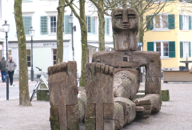
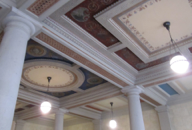
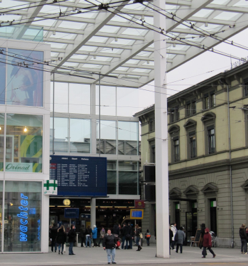
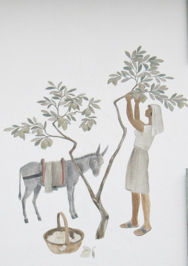
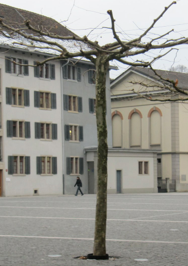
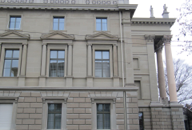
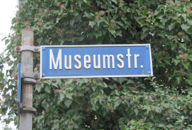
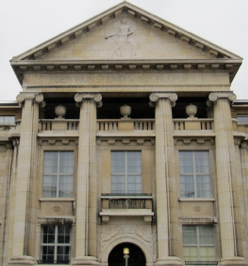
PHOTOS: Left Column: 1. A sign indicating the Museumstraße or Museum Street. Winterthur is an easy town to find one’s way. For example, there are streets that identify the destinations: Banhofstraße or Train Station Street, Bankstraße or Bank Street, Marketstraße, or Market Street, and Stadtstraße or City Street. 2. Detail: the portico of the Rathaus Winterthur or City Hall, c. 1781. 3. A Neo-Classical building on Museumstraße. 4. A charming sculpture built of logs is reminiscent of Baselitz sculpture. In this case, the children are allowed to climb upon the puppet that sits in the park esplanade of one of Winterthurr’s boulevards. Center, Top: Kunstmuseum Winterthur, built in 1915 in Neo-Classical Architecture. Center, Bottom: The Winterthur Bahnhof, one of the busiest in Switzerland. With its close proximity to Zürich, the train station handles approximately 122,000 thousand travelers and commuters per day. Right Column: 1. Painting on a building in the Old Town. 2. A square in the Old Town in winter.

Museums