Prostration
Barkhor square, central lhasa,
EASTERN Tibet, China
November 24-28, 2009


Prostration
Barkhor square, central lhasa,
EASTERN Tibet, China
November 24-28, 2009

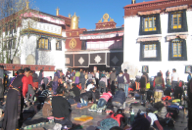
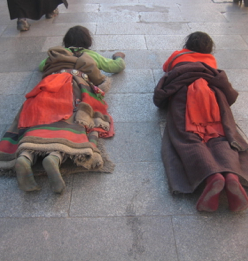
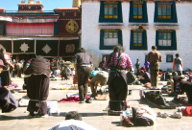
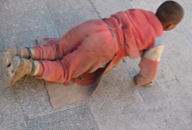
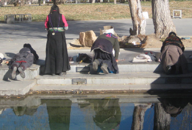
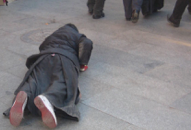
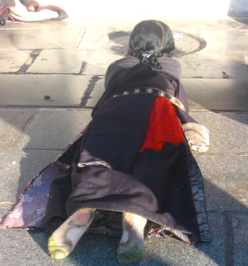
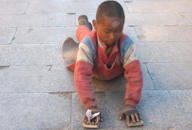
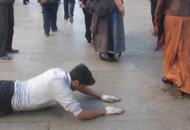
I was prepared to see the Tibetan practice of prostration in pilgrims along the highway, but nothing prepared me for seeing the people practicing prostration beneath my own feet! The first sight I had of this rigorous religious practice was in Barkhor Square in Lhasa. Here, in front of the most revered religious structure in Tibet, the Jokhang, what seemed to be a mass of hundreds of Tibetans prostrated themselves. People were in their native dress or western dress, and some had narrow padded cushions, and other laid flat on the ground. The rhythm of the bodies: standing, kneeling, lying down with arms outstretched in front, kneeling, then standing once again, was exaggerated by the late afternoon shadows cast on the whitewashed surface of the temple. A scraping sound also punctuated the activity, with many different devices used to protect the hands. Some of the devoted used wooden pads, held onto their hands with leather straps. Others wore gloves, some with a rubber surface on the palm side. A popular solution, which aided in the practice, was the use of plastic that seemed to have been cut from the sides of large plastic bottles. These plastic skids aided in the outstretched arms, the last motion in the prostration, making the slick, sliding sound we heard most often. Walking along the kora, or circumambulation route which took us through the market streets of the Barkhor, we also encountered several people prostrating themselves on this pilgrimage route. Walking with Henry amongst this jostling crowd, I was alerted to hear a rhythmic sound of clapping wood. When I turned around, a young boy, perhaps between ten and twelve years of age, was prostrating himself. He wore a canvas apron over his sweatsuit, thick socks and sturdy work boots. On his hands were the wooden skids held onto his hands by leather straps. He clapped the wood together in a prayer posture before kneeling, then playfully skidded the full length of his body. Marking the ending spot with a small stone, and his face with a big smile, he then stood, stepped forward to the mark, and repeated the process. His forehead had a big circular smudge of dust on it where it had repeatedly touched the ground in prayer. Further along, we encountered a matched pair of young women with long braids, and layers of skirts, bundled sweaters and jackets tied around their waists. They purposely timed each prostration in support of one another, following the circumambulation route one body length at a time. The most unusual prostration we encountered, however, was a strapping 20-something year old man, who chose to prostrate himself horizontally, completing the kora, or circumambulation, one body width, not length, at a time.
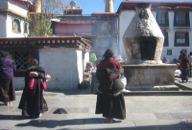
PHOTOS: Left Column: 1. The late afternoon scene at Barkhor Square in front of the Jokhang temple : a mass of people prostrating themselves. 2. Near one of four sangkang or incense burners, several women in traditional dress prostrate themselves. 3. A man in prostration on the circumambulation route. He is wearing a long black canvas apron to protect his clothing. 4. A group of women prostrating themselves in a park opposite the Potala Palace in Lhasa, another popular spot where the Tibetans demonstrate their respect and reverence. Center, Top: Two young women prostrating themselves on the pavement of the circumambulation route through the market of the Barkhor. Center, Bottom: A young woman resting on her elbows after prostrating herself before the Jokhang. Right Column: 1. The late afternoon scene at Barkhor Square in front of the Jokhang temple : a mass of people prostrating themselves. 2. View of a young boy, mid prostration, about to slide his hands ahead to lower his head to touch the ground. He seemed to be having such fun while doing this. The wooden skids made a great sound and gave him speed. 3.View from the front, showing his canvas apron and the smudge of dirt on his forehead, both evidence of his lying flat on the ground. 4. A young man prostrating himself horizontally, that is, making the circumambulation sideways instead of lengthwise, taking many more prostrations to complete the circuit.

In Reverence